Core Performance Characteristics
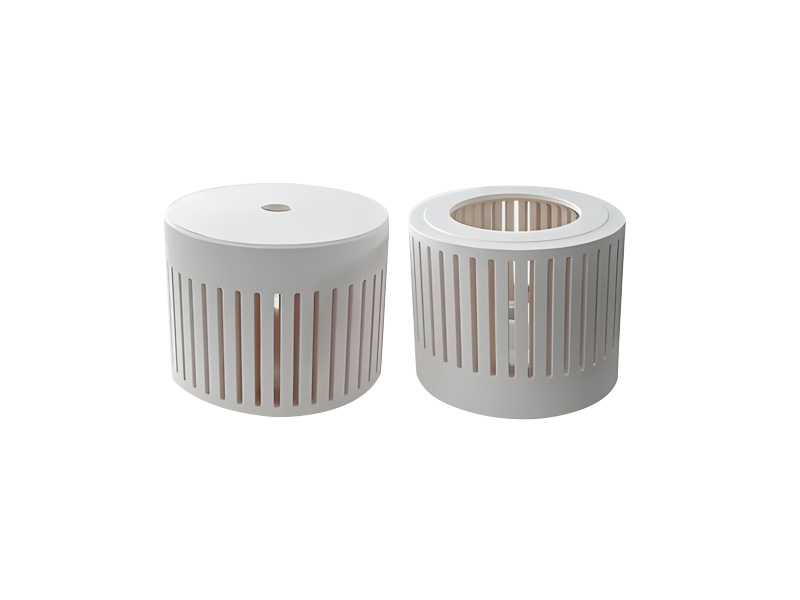
As a key component of the air jet mill, the alumina ceramic classifier wheel possesses the following significant performance characteristics:
1. Superior Wear Resistance: Alumina ceramic has a hardness exceeding HRA85 (Mohs hardness of 9, second only to diamond), offering extremely strong wear resistance and a significantly longer service life than metal classifier wheels.
2. No Metal Contamination: Made of pure ceramic, the classifier wheel is wear-resistant and does not easily produce debris, making it particularly suitable for applications requiring high purity, such as lithium-ion battery cathode materials, effectively avoiding metal contamination problems.
3. Excellent Surface Properties: The smooth surface of the ceramic material prevents material adhesion, which helps maintain classification accuracy and stability.
4. High Temperature Resistance: It can maintain stable performance at temperatures up to 1650°C, suitable for high-temperature industrial environments.
5. Chemical Stability: It exhibits excellent resistance to acid and alkali corrosion, enabling long-term stable operation in corrosive environments.
6. Insulation Performance: The insulation strength can reach 18KV, suitable for applications requiring high insulation, such as electronic and medical equipment.
Performance in Industrial Applications
In practical industrial applications, alumina ceramic air classifier wheels demonstrate the following excellent performance:
1. High classification accuracy: Capable of achieving micron or even sub-micron level classification with uniform particle size distribution (d97/d75/d25 = 1.1–1.5), and a Newton efficiency of 70–95%.
2. Long service life: A case study from a mining group shows a 40% reduction in equipment maintenance costs and a 25% increase in production efficiency.
3. High efficiency and energy saving: Utilizing aerodynamic principles, it has low energy consumption, stable operation, and low noise.
4. Wide range of applications: Suitable for high-hardness and abrasive materials such as alumina, silica, and silicon carbide, and widely used in ceramic materials, lithium battery materials, fine chemicals, and other fields.
5. Environmental advantages: Fully enclosed negative pressure operation ensures no dust pollution, and waste ceramics can be recycled.
Comparative advantage analysis
Compared to traditional metal classification wheels, alumina ceramic classification wheels offer several advantages:
Comparison dimensions | Alumina ceramic classifier wheel | Metal grading wheel |
Wear resistance | With a Mohs hardness of 9, its wear resistance is more than 10 times that of stainless steel. | It has relatively low wear resistance and requires frequent replacement in high-wear environments. |
High-temperature performance | Stable operation at 1650°C. | It deforms easily at high temperatures and requires an additional cooling system. |
Chemical stability | Resistant to acid and alkali corrosion. | Surface treatment is required to improve corrosion resistance. |
Insulation performance | Excellent insulation properties (>10¹⁴ Ω·cm) | Conductive, easily generates electrical sparks. |
Total life cycle cost | The initial cost is high, but the maintenance costs are low, resulting in significant long-term overall benefits. | Low initial cost but frequent maintenance and replacement are required. |
Supports custom specifications.