




The High-Temperature Engineering Challenge
Designing components for environments exceeding 800°C presents a brutal materials science paradox. Metals and superalloys (like Inconel or titanium) begin to soften, creep, and oxidize rapidly, requiring complex and heavy internal cooling channels. Polymers melt or decompose instantly. Conventional oxide ceramics (like Alumina or Zirconia) can survive the heat but will shatter catastrophically if subjected to rapid temperature fluctuations (thermal shock) or mechanical impact.
Silicon Nitride (Si₃N₄) breaks this paradox. It is one of the very few engineering materials on Earth that simultaneously offers extreme heat resistance (up to 1400°C), unmatched thermal shock survival, high mechanical strength, and low density. Unlike metals, it does not soften as temperatures rise; in fact, its strength remains remarkably stable. This unique profile makes Si₃N₄ the enabling material for next-generation gas turbines, automotive turbochargers, aerospace propulsion, and advanced metallurgical processing.
Key Thermal & High-Temperature Properties of Si₃N₄
The following metrics define why Si₃N₄ outperforms almost every other material in extreme heat environments:
| Property | Si₃N₄ Value | High-Temp Engineering Significance |
|---|---|---|
| Max Service Temp (Inert) | 1400°C | Maintains structural integrity in furnaces & kilns |
| Max Service Temp (Air/Oxidizing) | 1200°C - 1300°C | Passivation layer protects against continuous oxidation |
| High-Temp Strength Retention | ~100% at 1200°C | Does not soften or yield like metals at elevated heat |
| Thermal Shock Resistance (ΔT) | > 800°C | Survives rapid quenching without cracking |
| Coefficient of Thermal Expansion | 3.2 × 10⁻⁶/°C | Extremely low expansion minimizes thermal stress |
| Creep Resistance | Excellent | Resists slow deformation under constant high-temp load |
| Thermal Conductivity | 20-30 W/m·K | Dissipates localized hot spots, preventing thermal runaway |
How Si₃N₄ Survives: Strength Retention & Oxidation Protection
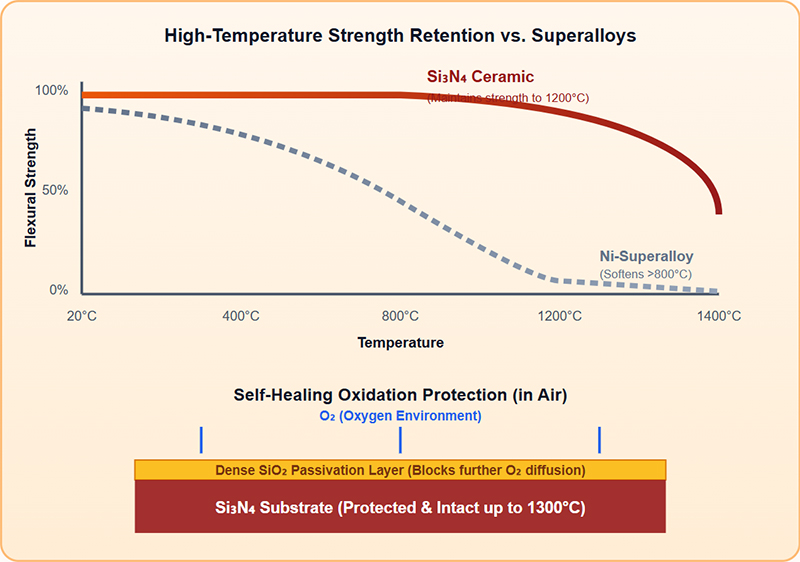
Unlike metals that lose strength linearly as temperature rises, Si₃N₄ maintains its mechanical integrity. Furthermore, in oxygen-rich environments, it employs a "self-healing" oxidation mechanism. The diagram below illustrates these two critical high-temperature survival mechanisms:
Diagram 1: Si₃N₄ High-Temperature Strength & Passivation Mechanism
The Passivation Mechanism
When exposed to oxygen at high temperatures, the surface of Si₃N₄ reacts to form a thin, highly adherent, and dense layer of silica (SiO₂). This glassy layer acts as a diffusion barrier, preventing oxygen from reaching the underlying Si₃N₄ substrate. This "self-healing" passivation is what allows Si₃N₄ to survive continuous operation in air up to 1300°C.
The 1400°C Limit in Air
Above 1300°C-1400°C in oxidizing atmospheres, the protective SiO₂ layer begins to crystallize (cristobalite) or volatilize, losing its protective qualities. For continuous applications above 1400°C, Si₃N₄ must be used in inert (argon/nitrogen) or vacuum environments, where it can safely operate up to its decomposition point without degrading.
Core Advantages of Si₃N₄ in Extreme Heat
Unmatched Thermal Shock Survival
With a ΔT > 800°C, Si₃N₄ can be heated to red-hot and plunged into cold water without cracking. This makes it ideal for components that experience rapid heating/cooling cycles, like furnace fixtures or molten metal sensors.
Zero High-Temperature Creep
Under constant mechanical load at 1200°C, metals slowly deform (creep) and eventually fail. High-grade HIP-sintered Si₃N₄ exhibits virtually zero creep, maintaining exact dimensional tolerances in high-stress turbine and kiln applications.
Massive Centrifugal Load Reduction
At 3.2 g/cm³, Si₃N₄ is 60% lighter than superalloys. In high-speed, high-temperature rotating parts (like turbocharger rotors), this drastically reduces centrifugal stress on the shaft and bearings, allowing faster spool-up and higher RPM limits.
Molten Metal Non-Wetting
Si₃N₄ is chemically inert and non-wetting by most non-ferrous molten metals (Aluminum, Zinc, Copper). It won't alloy, dissolve, or contaminate the melt, making it the ultimate material for metallurgical handling and sensing.
High-Temperature Application Map by Industry
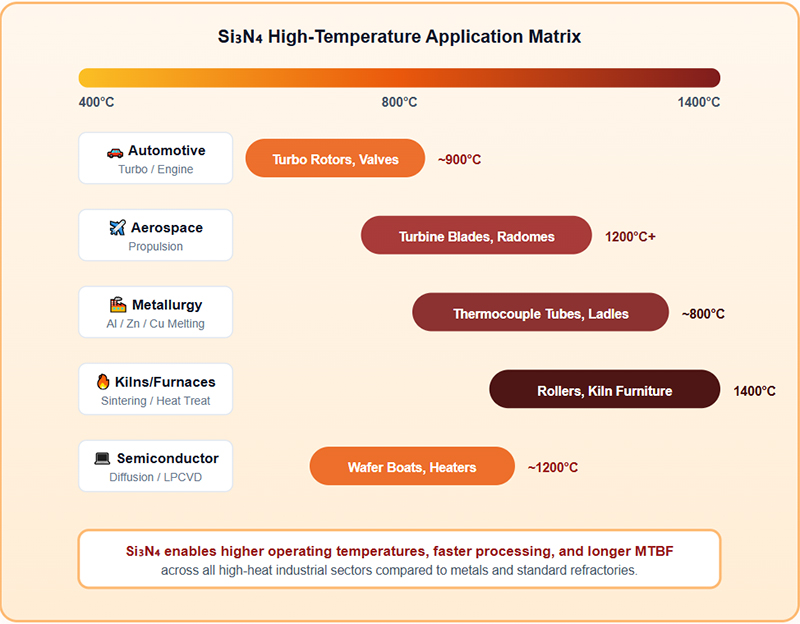
The following diagram maps the specific high-temperature components manufactured from Si₃N₄ to their respective industries and operating temperature ranges:
Diagram 2: Si₃N₄ High-Temp Components & Industry Deployment
Detailed Industrial Uses in Extreme Heat
Automotive Turbocharger Rotors
The Challenge: Exhaust gases exceed 900°C; heavy metal rotors suffer from high inertia, causing "turbo lag."
The Si₃N₄ Solution: Si₃N₄ rotors are 60% lighter, reducing the moment of inertia by over half. This allows the turbo to spool up instantly, eliminating lag, improving fuel efficiency, and surviving extreme thermal shock during sudden deceleration.
Metallurgical Thermocouple Tubes
The Challenge: Sensors immersed in molten aluminum or copper face extreme thermal shock, chemical corrosion, and melt contamination.
The Si₃N₄ Solution: Si₃N₄ protection tubes survive the thermal shock of immersion, do not react with or contaminate the non-ferrous melt (non-wetting), and last 10× longer than standard cast iron or alumina tubes.
Industrial Furnace Rollers & Kiln Furniture
The Challenge: Kiln shelves and continuous furnace rollers sag (creep) and crack under heavy loads at 1300°C+.
The Si₃N₄ Solution: Si₃N₄ fixtures exhibit zero creep at 1400°C, allowing thinner, lighter kiln shelves that maximize furnace volume. They survive rapid heating/cooling cycles without warping or cracking.
Aerospace Gas Turbine Components
The Challenge: Jet engines require higher turbine inlet temperatures for better thrust and efficiency, but superalloys melt and require heavy cooling air.
The Si₃N₄ Solution: Si₃N₄ turbine blades and shrouds operate at temperatures >1200°C without internal cooling, significantly increasing engine thermal efficiency and thrust-to-weight ratios.
Semiconductor Diffusion Furnaces
The Challenge: Wafer boats in LPCVD and diffusion furnaces operate at 1200°C, where quartz sags and contaminates wafers.
The Si₃N₄ Solution: Si₃N₄ wafer carriers maintain perfect flatness (zero creep) at 1200°C, do not outgas, and prevent particulate contamination, ensuring high semiconductor yield.
High-Temp Welding & Machining Fixtures
The Challenge: Jigs and fixtures used in automated welding or high-speed dry machining absorb massive localized heat and warp.
The Si₃N₄ Solution: Si₃N₄ locator pins, insulators, and welding nozzles resist spatter adhesion, maintain exact dimensional tolerances under intense localized heat, and electrically isolate the workpiece.
High-Temperature Material Comparison: Si₃N₄ vs Alternatives
| High-Temp Property | Si₃N₄ | SiC | Al₂O₃ | ZrO₂ | Ni-Superalloy |
|---|---|---|---|---|---|
| Max Use Temp (Air) | 1200-1300°C | 1500°C | 1200°C | 800°C | ~1000°C |
| Thermal Shock (ΔT) | >800°C ★ | ~400°C | ~200°C | ~300°C | N/A (Yields) |
| Strength at 1000°C | ~100% RT ★ | ~90% RT | ~60% RT | ~40% RT | ~30% RT |
| Fracture Toughness | 6-8 ★ | 3-5 | 3-5 | 5-8 | High |
| Density (g/cm³) | 3.2 ★ | 3.2 | 3.9 | 6.0 | 8.2 |
★ Best in category for dynamic, high-shock high-temperature applications. While SiC has a higher absolute max temperature, its low toughness makes it unsuitable for rotating or high-impact thermal environments where Si₃N₄ excels.
Why Partner With HUACIJULI for High-Temp Si₃N₄?
High-Purity HIP Sintering
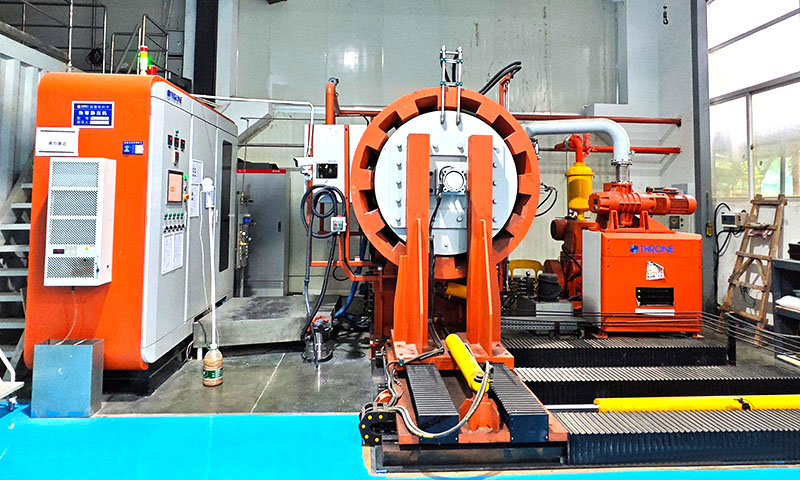
Our Hot Isostatic Pressing (HIP) process eliminates residual glassy grain boundary phases, maximizing creep resistance and high-temperature structural stability up to 1400°C.
Complex Geometry Machining
5-axis CNC diamond grinding allows us to produce complex high-temp shapes like turbocharger rotors, turbine blades, and custom furnace fixtures to exact tolerances.
Thermal Simulation Support
Our engineering team provides FEA (Finite Element Analysis) thermal and stress modeling to optimize your component design for extreme heat environments before manufacturing.
Pushing the Thermal Limits of Your Engineering?
Send us your high-temperature application requirements. Our materials scientists will engineer a custom Si₃N₄ solution to outperform your current materials.
Request High-Temp Engineering ConsultationFrequently Asked Questions (FAQ)
Q1: What is the absolute maximum temperature Si₃N₄ can withstand?
In inert or vacuum environments, Si₃N₄ can operate continuously up to 1400°C without structural degradation. In oxidizing environments (air), the safe continuous limit is 1200°C-1300°C, protected by a self-forming silica passivation layer.
Q2: Why doesn't Si₃N₄ shatter under rapid temperature changes?
Thermal shock resistance requires low thermal expansion, good heat conduction, and high toughness. Si₃N₄ has a uniquely low CTE (3.2 × 10⁻⁶/°C) combined with the highest fracture toughness of any ceramic (6-8 MPa·m½). This allows it to survive ΔT > 800°C (e.g., quenching from red-heat into water) without cracking.
Q3: How does Si₃N₄ compare to Inconel and steel at 1000°C?
At 1000°C, steel and Ni-superalloys have lost 50-70% of their room-temperature strength and suffer from creep. Si₃N₄ retains nearly 100% of its room-temperature strength at 1000°C, while also being 60% lighter and immune to high-temperature oxidation.
Q4: Can Si₃N₄ be used in contact with molten metals?
Yes. Si₃N₄ is highly resistant to wetting by non-ferrous molten metals like aluminum, zinc, and copper. It is widely used for thermocouple protection tubes, ladle linings, and transfer nozzles in the metallurgy industry because it does not react with or contaminate the melt. (Note: It is not recommended for molten iron or steel due to chemical reduction at extreme temperatures).