




Table of Contents
What Is Silicon Nitride Ceramic?
Silicon nitride (Si₃N₄) is a highly advanced, covalently bonded inorganic non-metallic material composed of silicon and nitrogen atoms. First synthesized in 1857, it wasn't until the mid-20th century that its extraordinary potential as a structural engineering ceramic was fully realized. Today, it stands at the pinnacle of advanced materials science, enabling technologies that push the boundaries of speed, temperature, and reliability.
Unlike oxide ceramics (like Alumina) that rely on ionic bonding, Si₃N₄ features strong covalent bonds (approx. 70% covalent, 30% ionic). This atomic structure is responsible for its exceptional hardness, high-temperature stability, and resistance to chemical attack. Si₃N₄ exists in two primary crystallographic phases: the low-temperature alpha (α) phase and the high-temperature beta (β) phase. During the manufacturing process, α-phase powder is transformed into elongated β-phase grains, creating a unique "self-reinforcing" microstructure that gives Si₃N₄ its legendary toughness.
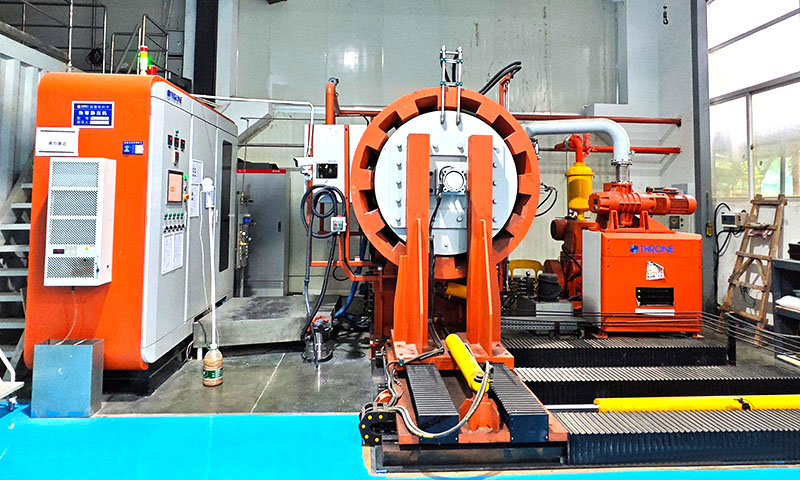
Because its covalent bonds make it impossible to sinter without additives, engineering-grade Si₃N₄ is produced using precise amounts of sintering aids (typically Y₂O₃ and Al₂O₃) and advanced densification techniques like Gas Pressure Sintering (GPS) or Hot Isostatic Pressing (HIP). The result is a near-net-shape, fully dense ceramic component ready for the most demanding applications on Earth and in space.
Key Material Properties of Si₃N₄
The following table summarizes the defining physical, mechanical, and thermal properties of sintered Silicon Nitride that make it indispensable for modern engineering:
| Property Category | Specific Property | Typical Value | Engineering Significance |
|---|---|---|---|
| Mechanical | Hardness (Vickers) | 13-17 GPa | Extreme wear & abrasion resistance |
| Fracture Toughness (KIC) | 6-8 MPa·m½ | Highest of any monolithic ceramic | |
| Flexural Strength | 700-1000 MPa | Survives high mechanical loading | |
| Thermal | Thermal Expansion (CTE) | 3.2 × 10⁻⁶/°C | Matches metals; minimal thermal stress |
| Thermal Conductivity | 20-30 W/m·K | Dissipates heat; prevents thermal runaway | |
| Thermal Shock Resistance | ΔT > 800°C | Survives rapid quenching without cracking | |
| Physical | Density | 3.2 g/cm³ | 60% lighter than steel; reduces inertia |
| Electrical Resistivity | > 10¹⁴ Ω·cm | Perfect electrical insulator | |
| Chemical | Corrosion Resistance | Excellent | Immune to most acids, alkalis, & molten metals |
The Secret of Si₃N₄ Toughness: Microstructure & Crack Bridging
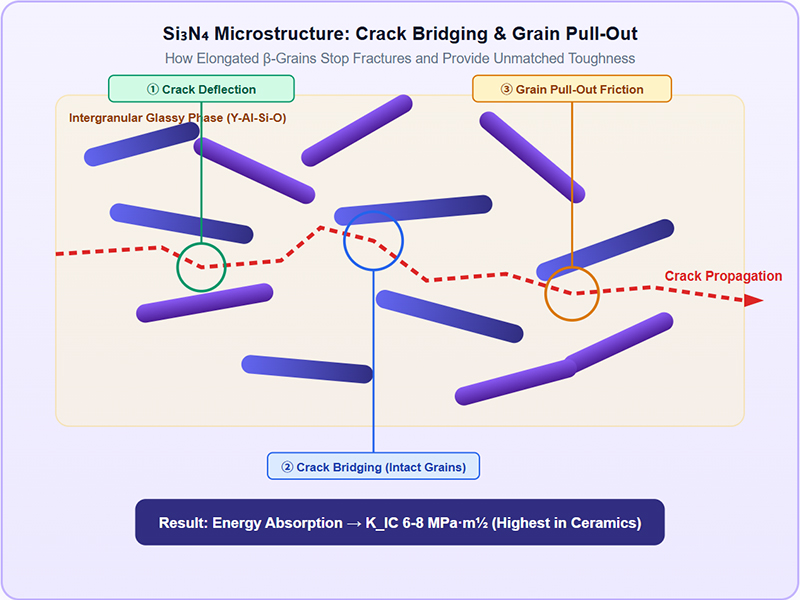
Why is Si₃N₄ so much tougher than other ceramics? The answer lies in its unique self-reinforcing microstructure. The following diagram illustrates how elongated β-Si₃N₄ grains create "crack-bridging" mechanisms that stop fractures from propagating a feature entirely absent in equiaxed ceramics like Al₂O₃ or SiC:
Diagram 1: Si₃N₄ Crack-Bridging Toughening Mechanism
Extended Knowledge: α to β Phase Transformation
During sintering at >1750°C, the starting α-Si₃N₄ powder dissolves into the liquid glassy phase and reprecipitates as elongated β-Si₃N₄ grains. By precisely controlling sintering temperature, time, and nitrogen pressure, materials scientists tune the grain aspect ratio (length-to-width). Higher aspect ratios yield higher toughness, while finer grains yield higher strength.
Why Al₂O₃ and SiC Are Brittle
Conventional ceramics like Alumina (Al₂O₃) and Silicon Carbide (SiC) consist of equiaxed (round/blocky) grains. When a crack starts, it travels straight through the grain boundaries with zero resistance, causing instant catastrophic shattering. Si₃N₄'s elongated grains force cracks to zigzag, bridge, and expend energy 0-fundamentally changing the failure mode from brittle to quasi-ductile.
Core Advantages of Silicon Nitride
When engineers specify Si₃N₄, they are typically solving a specific failure mode that limits metals or other ceramics. Here are the primary advantages:
Unmatched Damage Tolerance
With KIC up to 8 MPa·m½, Si₃N₄ survives impact loads, pressure surges, and particle ingestion that would shatter SiC or Al₂O₃ instantly. It is the only ceramic safe for dynamic, high-shock applications.
Extreme Thermal Shock Survival
Its low CTE (3.2 ppm/K) combined with moderate thermal conductivity and high strength allows Si₃N₄ to survive rapid quenching from 800°C into cold water without cracking - a feat impossible for most metals or oxides.
Massive Weight Reduction
At 3.2 g/cm³, Si₃N₄ is 40% the weight of steel and 22% the weight of tungsten carbide. In high-speed rotating parts (bearings, turbines), this reduces centrifugal forces by 60%, enabling higher RPMs and lower power consumption.
Electrical & Magnetic Neutrality
Si₃N₄ is a perfect electrical insulator and completely non-magnetic. This prevents electrical discharge machining (EDM) pitting in EV motor bearings and allows use in MRI machines and semiconductor plasma chambers.
Universal Chemical Inertness
Si₃N₄ is virtually immune to attack by acids, alkalis, and organic solvents. Crucially, it is non-wetting by molten non-ferrous metals (Al, Zn, Cu), making it the ultimate material for metallurgical handling.
High-Temperature Strength Retention
While steel loses 50% of its strength by 500°C, high-grade Si₃N₄ maintains its full room-temperature strength and hardness up to 1200°C-1400°C, enabling use in jet engines and industrial furnaces.
Si₃N₄ vs. Alternative Materials: The Performance Map
The following radar chart visually compares Silicon Nitride against four common engineering materials across six critical performance axes. Notice how Si₃N₄ (Indigo) dominates the outer edges of the chart, representing the most balanced and comprehensive property profile:
SVG Diagram 2: Multi-Axis Material Performance Radar Chart
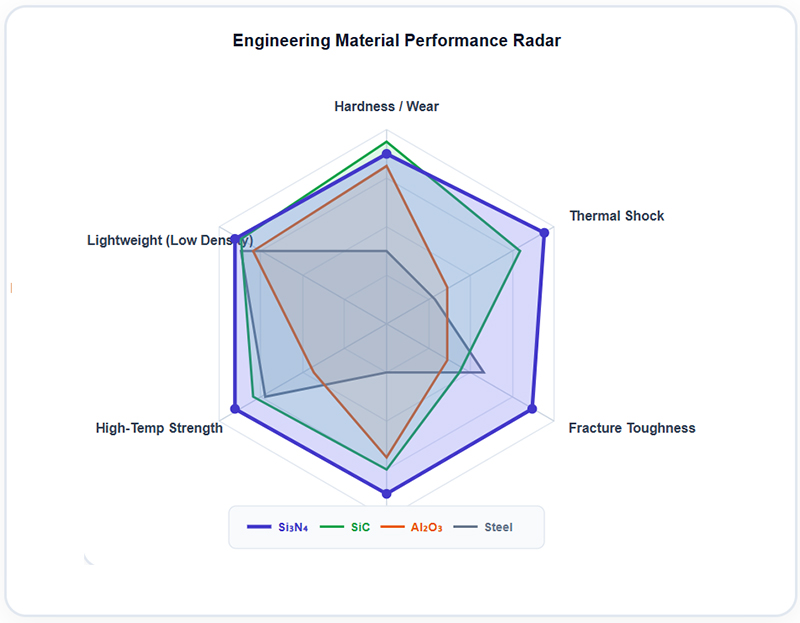
Note: While SiC edges out Si₃N₄ slightly in pure hardness, Si₃N₄'s massive advantage in Fracture Toughness and Thermal Shock makes it the superior choice for dynamic, real-world engineering environments.
Industrial Uses & Applications of Si₃N₄
Because of its versatile property profile, Silicon Nitride has transitioned from a niche laboratory material to a critical enabling technology across multiple global industries:
Bearings & Tribology
Uses: Hybrid ceramic ball bearings, wind turbine main shaft bearings, EV traction motor bearings, machine tool spindle bearings.
Why Si₃N₄: 60% weight reduction lowers centrifugal forces at high RPMs. Electrical insulation prevents EDM pitting in EV motors. Runs reliably with marginal lubrication.
Automotive & EV Powertrains
Uses: Turbocharger rotors, engine valve lifters, glow plugs, and critically, AMB (Active Metal Brazing) substrates for SiC/IGBT power modules in EV inverters.
Why Si₃N₄: High thermal fatigue resistance allows AMB substrates to survive >10,000 thermal cycles without copper delamination.
Aerospace & Defense
Uses: Gas turbine main shaft bearings, radomes, missile nose cones, aerospace fasteners, and satellite structural components.
Why Si₃N₄: Maintains strength at >1000°C, lightweight, and transparent to radar frequencies (radomes). Survives extreme thermal cycling of space environments.
Metallurgy & Metal Processing
Uses: Thermocouple protection tubes, crucibles, ladle components, continuous caster roll bearings, and molten metal transfer nozzles.
Why Si₃N₄: Non-wetting by molten aluminum, zinc, and copper. Immune to thermal shock when plunged into molten metal. Does not contaminate the melt.
Semiconductor Manufacturing
Uses: Wafer boat carriers, focus rings for etch chambers, CMP retaining rings, and heater covers.
Why Si₃N₄: Ultra-low particle generation, high plasma erosion resistance (superior to quartz), and no metallic contamination in cleanroom environments.
Cutting Tools & Machining
Uses: Indexable inserts for high-speed machining of cast iron, superalloys (Inconel), and hardened steels.
Why Si₃N₄: Extreme hot hardness allows dry machining at speeds 5-10× faster than carbide tools. Chemical stability prevents crater wear and built-up edge.
Si₃N₄ vs. Other Engineering Materials
| Property | Si₃N₄ | Al₂O₃ | ZrO₂ | SiC | Bearing Steel |
|---|---|---|---|---|---|
| Density (g/cm³) | 3.2 | 3.9 | 6.0 | 3.2 | 7.8 |
| Fracture Toughness (MPa·m½) | 6-8 ★ | 3-5 | 5-8 | 3-5 | 15-25 |
| Thermal Shock (ΔT °C) | >800 ★ | ~200 | ~300 | ~400 | N/A |
| Max Use Temp (°C) | 1400 ★ | 1200 | 800 | 1600 | ~200 |
| Electrical Insulation | Excellent ★ | Excellent | Good | Semiconductor | Conductor |
Why Partner With HUACIJULI for Si₃N₄ Solutions?
Material Science Mastery
We don't just machine Si₃N₄; we engineer the microstructure. From powder chemistry to β-grain aspect ratio control, we optimize the material for your specific application.
End-to-End Manufacturing
In-house GPS/HIP sintering, 5-axis CNC diamond grinding, lapping, and polishing. From raw powder to finished, inspected components under one roof.
Global Application Support
Our engineering team works directly with your designers to solve thermal, wear, and structural challenges, providing DFM (Design for Manufacturability) feedback.
Ready to Upgrade Your Engineering with Si₃N₄?
Contact our materials science team to discuss your application and receive a custom Silicon Nitride solution.
Contact HUACIJULI EngineeringFrequently Asked Questions (FAQ)
Q1: What exactly is silicon nitride ceramic?
Silicon nitride (Si₃N₄) is an advanced covalently bonded structural ceramic. In its engineered form, it features an interlocking microstructure of elongated β-grains that provides the highest fracture toughness of any monolithic ceramic, combined with extreme hardness, low density, and exceptional thermal shock resistance.
Q2: What makes Si₃N₄ better than other ceramics like Al₂O₃ or SiC?
The primary advantage is damage tolerance. While Al₂O₃ and SiC are brittle and shatter under impact or rapid temperature changes, Si₃N₄'s elongated grain structure creates "crack-bridging" mechanisms that stop fractures from propagating. This gives it 2× the fracture toughness of SiC and superior thermal shock resistance, making it reliable in dynamic, high-stress environments.
Q3: What are the most common industrial uses for Si₃N₄?
Major uses include hybrid ceramic bearings (EVs, aerospace, wind turbines), AMB power substrates for EV inverters, cutting tool inserts for high-speed machining, molten metal handling components (thermocouple tubes, crucibles), and semiconductor fabrication equipment (wafer carriers, etch rings).
Q4: Can Si₃N₄ replace steel in high-temperature applications?
Yes. While bearing steel loses structural integrity above 200°C and tool steel softens above 500°C, high-grade Si₃N₄ maintains its full room-temperature strength and hardness up to 1200°C-1400°C. Additionally, it is 60% lighter, electrically insulating, and immune to oxidation and corrosion, solving multiple failure modes simultaneously.