




What Exactly Is a Silicon Nitride Ceramic Bearing Ball?
A silicon nitride ceramic bearing ball is a precision-engineered spherical rolling element manufactured from dense, fine-grained Si₃N₄ ceramic. It functions as the primary load-transmitting component within rolling-element bearings, replacing or complementing traditional steel balls in applications demanding higher speed, lower weight, electrical isolation, or extreme-environment survivability.
Unlike commodity ceramic spheres used for decorative or check-valve purposes, bearing-grade Si₃N₄ balls are manufactured to ISO 3290 precision tolerances with sphericity deviations measured in sub-micron ranges, surface finishes below Ra 0.01 μm, and microstructural quality verified through non-destructive testing. Every ball must withstand Hertzian contact stresses exceeding 3 GPa at operational speeds up to DN = 2,000,000 mm·RPM.
Material Science Foundation
Si₃N₄ exists in two crystalline phases: α-Si₃N₄ (metastable, equiaxed grains) and β-Si₃N₄ (stable, elongated rod-like grains). Bearing-grade material is engineered to contain >95% β-phase with interlocked acicular grain morphology. This microstructure enables crack deflection and grain pull-out toughening mechanisms that give Si₃N₄ its exceptional fracture toughness among monolithic ceramics.
Sintering Routes for Bearing Grade
Two processes produce bearing-quality Si₃N₄: Gas Pressure Sintering (GPSN) at 1-10 MPa N₂ yields near-full density with controlled grain growth; Hot Isostatic Pressing (HIP) at 100-200 MPa achieves theoretical density (>99.9%) with minimal porosity. HIP-ed material is preferred for aerospace and premium EV bearings where zero-defect reliability is mandatory. Both routes use Y₂O₃/MgO or rare-earth oxide sintering aids.
Key Properties: Why Si₃N₄ Dominates Ceramic Bearing Applications
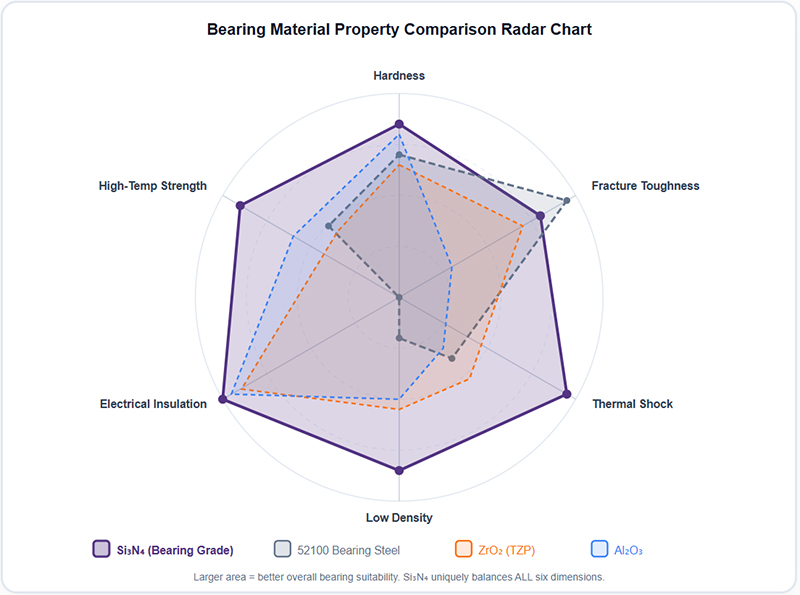
Silicon nitride's dominance in bearing applications is not accidental-it results from a uniquely balanced property portfolio that no other engineering material replicates. The following visualization compares Si₃N₄ against bearing steel and competing ceramics across six critical performance dimensions.
Diagram 1: Si₃N₄ vs. Bearing Steel vs. Competing Ceramics - Property Radar Comparison
| Property | Si₃N₄ (Bearing Grade) | 52100 Steel | ZrO₂ (TZP) | Al₂O₃ |
|---|---|---|---|---|
| Density (g/cm³) | 3.20 | 7.85 | 6.00 | 3.95 |
| Hardness (HV) | 1600-1800 | 750-850 | 1200-1350 | 1500-1700 |
| Fracture Toughness KIC (MPa·m½) | 6.0-8.0 | 15-25 | 5.0-6.5 | 3.0-4.0 |
| Elastic Modulus (GPa) | 310 | 210 | 210 | 380 |
| Max Service Temp (°C, air) | 1200 | 150 | 250 | 1000 |
| Electrical Resistivity (Ω·cm) | >10¹⁴ | ~10⁻⁵ | >10¹² | >10¹⁴ |
| CTE (ppm/K) | 3.2 | 12.0 | 10.0 | 8.0 |
Extended Knowledge: The Elastic Modulus Advantage
Si₃N₄'s elastic modulus (~310 GPa) sits in a "Goldilocks zone" for hybrid bearings. It is significantly higher than steel (210 GPa), ensuring the ceramic ball carries adequate load share, yet substantially lower than Al₂O₃ (380 GPa). This moderate stiffness means Si₃N₄ balls elastically conform slightly to steel raceway curvature under load, distributing Hertzian contact pressure over a larger area and reducing peak subsurface shear stress. Al₂O₃'s higher stiffness creates sharper stress gradients at the ceramic-steel interface, accelerating raceway spalling in hybrid configurations. This mechanical compatibility is a key reason Si₃N₄ dominates hybrid bearing applications despite Al₂O₃'s comparable hardness.
Manufacturing Process & Precision Grade Classification
Producing bearing-grade Si₃N₄ balls requires mastering a multi-stage process chain where each step directly influences final precision, microstructural integrity, and fatigue life. The manufacturing route distinguishes true bearing balls from commodity ceramic spheres.
Powder Preparation
High-purity α-Si₃N₄ powder + sintering aids milled to D50 <0.5 μm. Oxygen content controlled <1.5 wt%.
Green Forming
Cold Isostatic Pressing (CIP) at 200-300 MPa into spherical preforms. Uniform green density >55% TD critical.
Sintering (GPSN/HIP)
1700-1900°C under N₂ pressure. Full α→β phase transformation. Final density >99.5% TD (GPSN) or >99.9% (HIP).
Precision Lapping
Multi-stage diamond abrasive lapping. Achieves target grade sphericity, size tolerance, and Ra <0.01 μm surface finish.
Quality Inspection
100% visual + dimensional sorting. Ultrasonic NDT for subsurface defects. Statistical lot certification per ISO 3290.
ISO 3290 Precision Grade Reference
| Grade | Sphericity (μm) | Size Tolerance (μm) | Surface Ra (μm) | Typical Application |
|---|---|---|---|---|
| G3 | 0.08 | ±0.5 | ≤0.005 | Aerospace gyroscopes, precision instruments |
| G5 | 0.13 | ±0.8 | ≤0.008 | Machine tool spindles, EV e-axles (premium) |
| G10 | 0.25 | ±1.5 | ≤0.012 | Industrial motors, pumps, general hybrid bearings |
| G16 | 0.40 | ±2.5 | ≤0.020 | Automotive accessories, conveyors |
| G20 | 0.50 | ±3.0 | ≤0.025 | Check valves, non-precision industrial |
Hybrid Bearings vs. Full-Ceramic Bearings: Configuration Selection
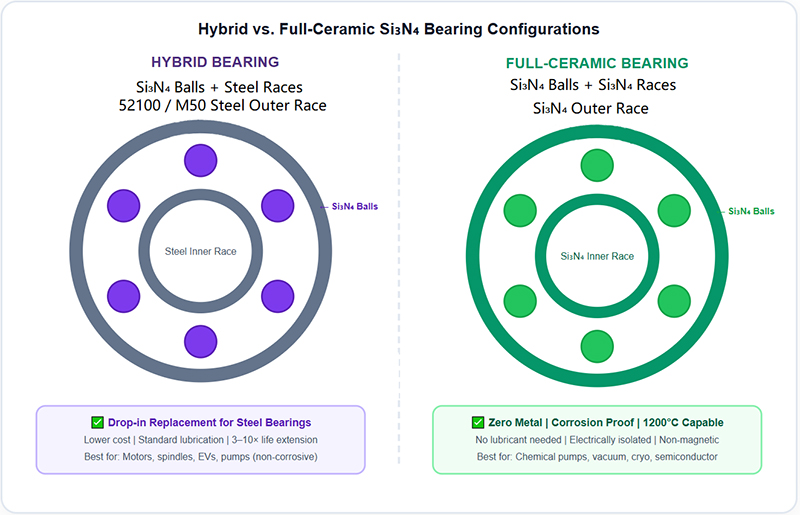
Si₃N₄ bearing balls are deployed in two fundamentally different bearing architectures. Understanding the distinction is critical for correct specification-misapplication leads to either unnecessary cost or premature failure.
Diagram 2: Hybrid vs. Full-Ceramic Bearing Architecture Comparison
When to Choose Hybrid
● Standard operating environment (no corrosion/extreme temp)
● Need drop-in dimensional interchangeability with steel bearings
● Budget-sensitive with 3–10× life improvement target
● Conventional oil/grease lubrication available
● Speed increase or electrical erosion prevention needed
When to Choose Full-Ceramic
● Corrosive chemicals, acids, alkalis, or saltwater exposure
● Operating temperature >300°C or cryogenic (<-100°C)
● Vacuum or cleanroom environments (no outgassing/lubricant)
● Complete electrical isolation mandatory (semiconductor)
● Non-magnetic requirement (MRI, particle accelerators)
Critical Applications Across Industries
Si₃N₄ bearing balls have transitioned from niche aerospace components to mainstream industrial solutions. The following map illustrates the expanding application frontier across five major sectors.
Diagram 3: Si₃N₄ Bearing Ball Application Landscape by Industry
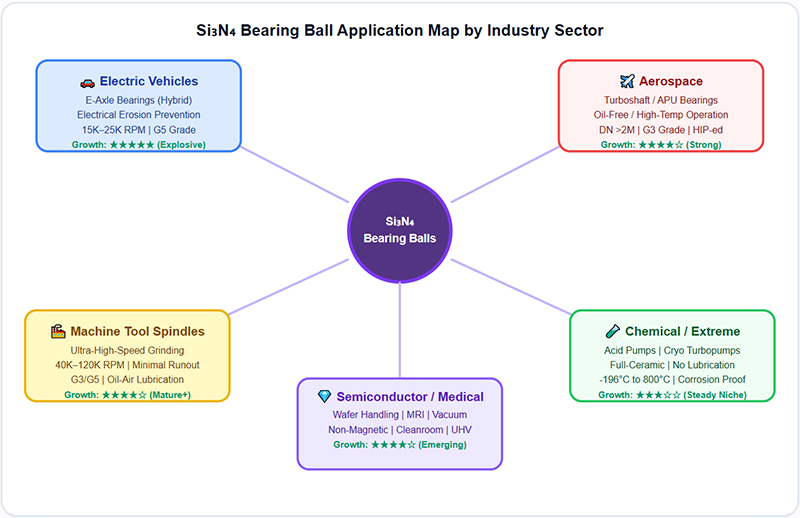
EV E-Axle Bearings: The Growth Engine
Problem: Inverter-induced bearing currents cause fluting failure in steel bearings within 20K–50K km.
Si₃N₄ Solution: Electrical resistivity >10¹⁴ Ω·cm blocks current entirely. 40% lower density reduces centrifugal raceway loading at 20K+ RPM. Result: 3-5× L₁₀ life vs. all-steel, now standard in Tesla, BYD, and VW MEB platforms.
Machine Tool Spindles: Speed Enabler
Problem: Steel ball centrifugal force limits spindle DN to ~1.5M. Higher speeds require smaller bearings with reduced stiffness.
Si₃N₄ Solution: 40% mass reduction raises DN limit to >2.5M while maintaining bearing size and rigidity. Enables 120,000 RPM micro-grinding spindles for mold/die finishing with Ra <0.05 μm surface quality.
Aerospace Turboshafts: Reliability Multiplier
Problem: Gas turbine main shaft bearings operate at 300°C+ with marginal oil film. Steel bearings suffer reduced fatigue life and lubricant degradation.
Si₃N₄ Solution: Maintains full strength at 800°C+. Self-lubricating tribology provides safe margin during oil starvation events. 10× MTBO improvement in military turboshaft engines.
Chemical Pumps: Zero-Maintenance Sealing
Problem: Acid/alkali pump bearings corrode rapidly. Seal leakage contaminates product. Frequent replacement causes downtime.
Si₃N₄ Solution: Full-ceramic bearings immune to all acids (except HF). Operate dry without lubrication. Maintenance-free for 5+ years in H₂SO₄, HCl, and NaOH transfer pumps.
Engineer's Selection Guide & Best Practices
Correct specification of Si₃N₄ bearing balls requires attention to grade, material quality, fit, lubrication, and handling. Follow this checklist to avoid common pitfalls.
Grade Selection Rules
● G3: Aerospace gyros, metrology, dn >2M
● G5: Premium EV, machine tool spindles, medical
● G10: Industrial motors, pumps, fans, gearboxes
● G16-G20: Non-precision, check valves, conveyors
● Never mix grades within same bearing assembly
Material Quality Verification
● Density ≥3.20 g/cm³ (Archimedes verification)
● HV ≥1600 (microhardness spot check)
● KIC ≥6.0 MPa·m½ (SENB or IF method)
● Ultrasonic NDT: zero subsurface defects >50 μm
● β-phase content ≥95% (XRD confirmation)
Critical Handling Precautions
● NEVER drop ceramic balls - internal cracks are invisible
● Use plastic-tipped tools only for installation
● Avoid metal-to-ceramic impact during assembly
● Store in original packaging; prevent ball-to-ball contact
● Clean with IPA only; never use acidic cleaners
Lubrication Guidelines
● Hybrid: Standard grease/oil OK; reduce quantity 20–30%
● Full-Ceramic: Can run dry; PTFE/MoS₂ coating optional
● Si₃N₄ forms tribofilm with most synthetic oils
● Avoid EP additives with sulfur/phosphorus in full-ceramic
● Re-lubrication intervals extended 3–5× vs. all-steel
Engineering Frequently Asked Questions
Q1: What exactly is a silicon nitride ceramic bearing ball?
A silicon nitride (Si₃N₄) ceramic bearing ball is a precision spherical rolling element manufactured from hot-isostatically-pressed or gas-pressure-sintered silicon nitride ceramic. It serves as the load-carrying component in both hybrid bearings (ceramic balls + steel races) and full-ceramic bearings (all Si₃N₄ components). Si₃N₄ balls are distinguished by their low density (3.2 g/cm³, 40% of steel), high hardness (HV 1600-1800), excellent fracture toughness for a ceramic (6-8 MPa·m½), electrical insulation, and self-lubricating tribological behavior. They are produced to ISO 3290 precision grades ranging from G3 to G20.
Q2: Why are silicon nitride balls preferred over zirconia or alumina for bearings?
Si₃N₄ outperforms other ceramics due to three decisive advantages: (1) Fracture toughness of 6-8 MPa·m½ vs. 5-6 for ZrO₂ and 3-4 for Al₂O₃, providing superior impact resistance; (2) Moderate elastic modulus (~310 GPa) offering better elastic compliance with steel races in hybrid bearings than Al₂O₃'s stiffer 380 GPa; (3) Superior thermal shock resistance (ΔT >800°C) vs. ZrO₂'s phase instability above 200°C. While ZrO₂ has competitive toughness in some formulations, its higher density and temperature limitations make Si₃N₄ the definitive choice for high-speed, high-temperature bearing applications.
Q3: What is the difference between hybrid and full-ceramic bearings?
Hybrid bearings combine Si₃N₄ balls with steel races, leveraging ceramic advantages while maintaining steel race manufacturability and cost. They are drop-in replacements for all-steel bearings. Full-ceramic bearings use Si₃N₄ for both balls AND races, eliminating all metal. They are specified for corrosive environments, temperatures >300°C, complete electrical isolation, or unlubricated operation. Full-ceramic bearings cost 5-10× more than hybrids but are irreplaceable in chemical pumps, vacuum furnaces, cryogenic turbopumps, and semiconductor equipment.
Q4: How do Si₃N₄ bearing balls extend bearing life in EV e-axles?
EV e-axles face two unique failure modes: (1) Electrical erosion from inverter-induced currents causing raceway fluting within 20K-50K km; (2) High rotational speeds (15K-25K RPM) generating excessive centrifugal loading. Si₃N₄ balls solve both: their electrical resistivity (>10¹⁴ Ω·cm) blocks current passage entirely; their 40% lower density reduces centrifugal outer-race loading by 60%. Combined with superior boundary lubrication during regenerative braking torque reversals, Si₃N₄ hybrid bearings achieve 3-5× the L₁₀ life of all-steel equivalents in EV service.