





Redefining the Limits of Accuracy
In precision engineering, the margin for error is measured in nanometers. At this scale, the physical limitations of traditional materials-thermal expansion, elastic deformation, adhesive wear, and particulate generation-become the primary bottlenecks to system performance. Silicon nitride (Si₃N₄) ceramic balls have emerged as a critical enabling technology, solving these fundamental physics problems across metrology, optics, semiconductor manufacturing, and ultra-high-speed machining.
This article explores the precise material attributes that make Si₃N₄ indispensable in these fields, maps its core applications, and provides the mechanical context engineers need to integrate these components into next-generation precision systems.
The Material DNA: Why Si₃N₄ for Precision?
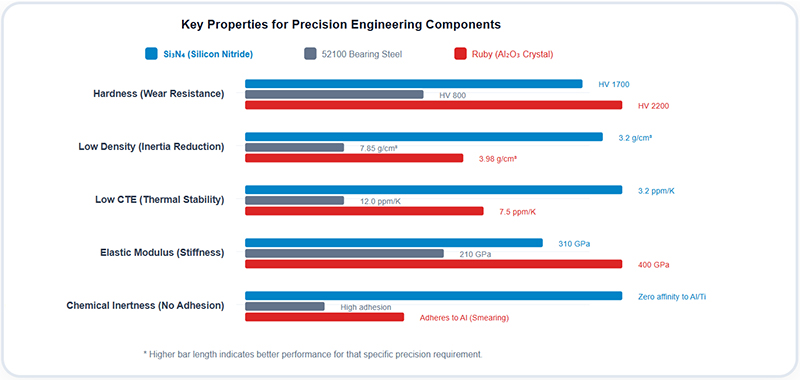
Precision engineering demands a unique combination of properties. A material must be hard enough to resist wear, light enough to minimize inertial forces, stiff enough to prevent elastic deflection, and thermally stable to avoid dimensional drift. The following comparison illustrates how Si₃N₄ uniquely satisfies this multi-variable optimization compared to traditional precision materials like bearing steel, ruby (single-crystal Al₂O₃), and zirconia.
Diagram 1: Precision Material Property Matrix
The Inertia Advantage
In high-speed scanning probes and rapid-traverse linear guides, the mass of the rolling element dictates the inertial forces. Si₃N₄'s density (3.2 g/cm³) is 59% lower than steel and 20% lower than ruby. This allows for faster acceleration/deceleration without inducing vibration, skidding, or false triggering in sensitive metrology probes.
Thermal Dimensional Stability
With a CTE of ~3.2 ppm/K, Si₃N₄ expands only one-quarter as much as steel when heated. In precision spindle bearings or optical positioning stages, this means frictional heat or ambient fluctuations cause negligible dimensional growth, maintaining sub-micron accuracy without complex thermal compensation algorithms.
Core Applications in Precision Engineering
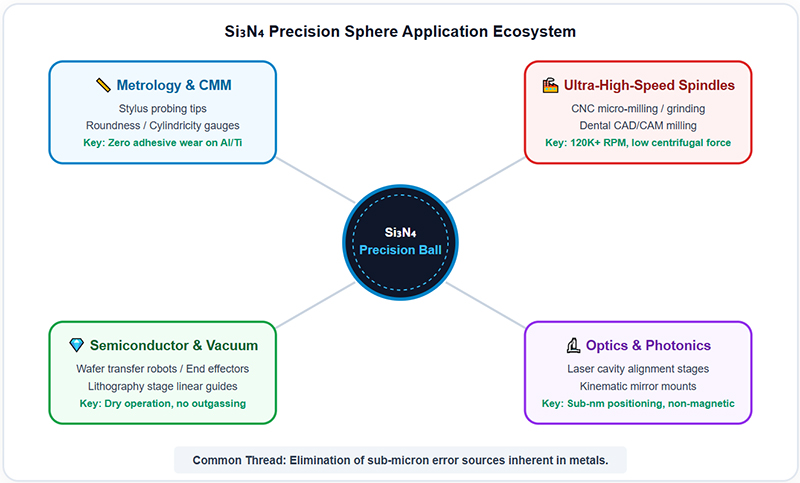
Si₃N₄ precision balls are not merely "upgrades" to steel; they are enabling components that allow entirely new classes of machinery to function. The application ecosystem spans four critical high-tech sectors.
Diagram 2: Si₃N₄ Precision Application Ecosystem
Metrology: The End of "Smearing"
When a ruby stylus scans an aluminum workpiece, a tribological phenomenon called "adhesive wear" causes aluminum to transfer onto the ruby tip (smearing). This builds up over time, altering the tip radius and introducing catastrophic measurement errors. Si₃N₄ has zero chemical affinity for aluminum or titanium, completely eliminating smearing and ensuring consistent nanometer-level accuracy over millions of probing cycles.
Optics: Kinematic Mount Perfection
Precision optical systems use kinematic mounts (three balls mating with three grooves) to define exact spatial coordinates. Si₃N₄ balls provide extreme hardness (preventing groove wear) and high stiffness (preventing elastic deflection under clamping loads). Their non-magnetic nature ensures they do not interfere with sensitive interferometers or electron beam equipment.
The Mechanics of Precision: Thermal Growth & Dynamic Stability
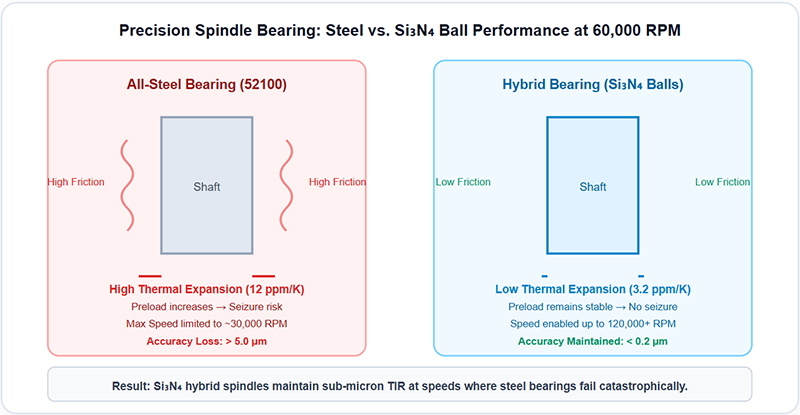
To understand why Si₃N₄ is specified in ultra-precision systems, we must quantify the mechanical and thermal behavior at the contact point. The following diagram illustrates the thermal growth differential in a high-speed spindle bearing, which is the primary driver for ceramic adoption in precision machining.
Diagram 3: Spindle Thermal Growth & Centrifugal Loading Comparison
Extended Knowledge: The "Skidding" Phenomenon
At ultra-high speeds, heavy steel balls cannot accelerate fast enough to match the rotational speed of the inner raceway, causing them to "skid" rather than roll. This skidding smears the raceway, generates immense localized heat, and destroys the bearing in minutes. Because Si₃N₄ balls are 60% lighter, their lower inertia allows them to instantly match the raceway speed, maintaining pure rolling contact and enabling the 100,000+ RPM speeds required for micro-machining precision optics and medical implants.
Semiconductor Manufacturing & Cleanroom Specifics
The semiconductor industry represents the absolute pinnacle of precision engineering requirements. Here, Si₃N₄ balls solve problems that no other material can address, specifically regarding contamination and vacuum compatibility.
ISO Class 1 Cleanroom Compliance
Steel bearings require grease that outgasses VOCs and sheds metallic particles. Si₃N₄'s self-lubricating tribology allows completely dry (unlubricated) operation. Any microscopic wear debris generated is electrically insulating and chemically inert, preventing the electrostatic attraction and short-circuiting that metallic dust causes on silicon wafers.
Ultra-High Vacuum (UHV) Compatibility
In processes like physical vapor deposition (PVD) or etching, bearings operate in hard vacuum. Liquid lubricants boil off instantly, and solid lubricants like MoS₂ can contaminate the process chamber. Si₃N₄ balls operate reliably in UHV environments (<10⁻⁹ Torr) without any lubricant, maintaining precise wafer positioning.
Electrostatic Discharge (ESD) Safety
While pure Si₃N₄ is an insulator, specialized slightly-conductive Si₃N₄ grades can be engineered for wafer-handling end-effectors. This prevents the buildup of static charge that could attract particles or damage sensitive microelectronics, while still avoiding the galvanic corrosion issues of metallic components.
Precision Grade & Selection Guide
Not all Si₃N₄ balls are created equal. Precision engineering demands strict adherence to ISO 3290 grading. Selecting the wrong grade will negate the material's inherent advantages.
| ISO Grade | Sphericity | Surface Finish (Ra) | Lot Size Variation | Precision Engineering Application |
|---|---|---|---|---|
| G3 | 0.08 μm | ≤ 0.005 μm | ± 0.5 μm | CMM stylus tips, lithography stages, optical kinematic mounts |
| G5 | 0.13 μm | ≤ 0.008 μm | ± 0.8 μm | Ultra-high-speed spindles (>60K RPM), semiconductor robot joints |
| G10 | 0.25 μm | ≤ 0.012 μm | ± 1.5 μm | Precision linear guides, roundness measuring machines |
| G16 / G20 | 0.40 - 0.50 μm | ≤ 0.020 μm | ± 2.5 - 3.0 μm | General industrial, precision check valves (non-metrology) |
Critical Warning: Handling Precision Ceramics
Si₃N₄ is extremely hard but brittle. A drop from just a few centimeters onto a hard surface can induce subsurface micro-cracks that are invisible to the naked eye but will cause catastrophic spalling under operational loads. Always use plastic-tipped tweezers, handle over soft mats, and never allow G3/G5 balls to strike each other or metal surfaces during assembly.
Engineering Frequently Asked Questions
Q1: Why are silicon nitride balls replacing ruby tips in CMM styluses?
Ruby suffers from "adhesive wear" when scanning aluminum or titanium, causing material transfer (smearing) that ruins measurement accuracy. Si₃N₄ exhibits zero chemical affinity with non-ferrous metals, eliminating smearing. Additionally, Si₃N₄ is 40% lighter than ruby, allowing for longer stylus shafts with less bending deflection and higher scanning speeds without false probe triggering due to inertia.
Q2: How do Si₃N₄ balls prevent contamination in semiconductor equipment?
Si₃N₄'s self-lubricating surface allows completely dry operation in vacuum or cleanrooms, eliminating VOC outgassing from greases. Any microscopic wear particles generated are electrically insulating and chemically inert, preventing the electrostatic attraction and short-circuiting failures associated with conductive metallic debris. This ensures ISO Class 1 cleanroom compliance.
Q3: What role does the CTE of Si₃N₄ play in precision positioning stages?
Si₃N₄ has an exceptionally low CTE (~3.2 ppm/K), roughly one-quarter that of steel. In sub-micron positioning systems (like lithography stages), thermal growth is the primary error source. By using Si₃N₄ balls in linear guides, engineers minimize thermally induced dimensional drift, ensuring nanometer-level repeatability even when frictional heat is generated during rapid traversals.
Q4: How does low density enable ultra-high-speed spindles?
Centrifugal force increases with the square of speed and is proportional to mass. Si₃N₄'s density is only 40% of steel, reducing centrifugal outer-race loading by 60%. This lowers contact stress, reduces heat, and prevents "skidding" (where heavy steel balls fail to match raceway speed, causing destructive sliding friction). This enables spindle speeds exceeding 120,000 RPM for micro-machining.