





The Core Mechanism: Self-Healing SiO₂ Passivation Layer
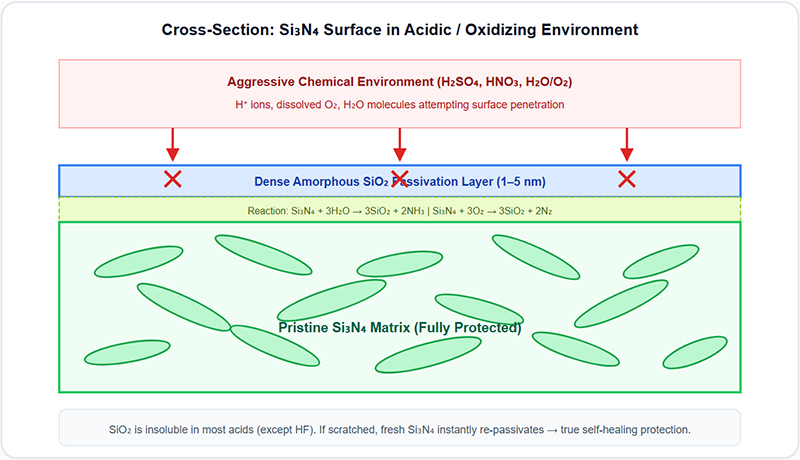
The primary reason silicon nitride exhibits near-total immunity to most acidic environments is not merely its bulk chemical inertness, but its ability to form a self-healing, nanometer-thick passivation layer of amorphous silicon dioxide (SiO₂) upon exposure to oxidizing media, water, or steam. This layer acts as an impermeable kinetic barrier between the aggressive environment and the underlying Si₃N₄ matrix.
Diagram 1: SiO₂ Passivation Layer Formation & Protection Mechanism
Oxidation-Driven Passivation
In oxidizing acids (HNO₃, H₂SO₄) or aerated aqueous solutions, surface Si₃N₄ oxidizes to SiO₂. Because the molar volume of SiO₂ exceeds that of Si₃N₄, the resulting film is under mild compressive stress—making it highly adherent, crack-free, and impermeable to further ionic transport.
Hydrolysis & Self-Healing
In pure water or steam, Si₃N₄ undergoes slow hydrolysis: Si₃N₄ + 6H₂O → 3SiO₂ + 4NH₃. The resulting SiO₂ protects the bulk. If mechanically worn (e.g., in a rotating seal face), the freshly exposed Si₃N₄ immediately re-passivates upon re-exposure to the fluid-a critical advantage over non-self-healing materials like Al₂O₃.
Covalent Bond Thermodynamics & Electrochemical Inertness
Beyond surface passivation, the bulk chemical inertness of Si₃N₄ is rooted in its fundamental atomic structure. Silicon nitride is a strongly covalent bonded compound with Si-N bond energies ranging from approximately 335 to 470 kJ/mol depending on local coordination. Breaking these bonds requires enormous activation energy, making spontaneous dissolution in aqueous media kinetically negligible at temperatures below 200°C.
Unlike metals (which corrode via electrochemical oxidation-reduction reactions) or ionic ceramics (which dissolve via ion exchange), the highly directional covalent bonds in Si₃N₄ do not readily ionize in solution. There is no anodic or cathodic site on a Si₃N₄ surface, rendering galvanic corrosion, pitting corrosion, and crevice corrosion entirely non-existent. This electrochemical inertness is why Si₃N₄ can be used in direct contact with dissimilar metals in electrolyte-rich environments without any risk of galvanic coupling.
Critical Exceptions: HF and Hot H₃PO₄
Fluorine has a higher electronegativity and stronger affinity for silicon than oxygen. Hydrofluoric acid (HF) aggressively dissolves the protective SiO₂ layer to form volatile SiF₄ gas, exposing bare Si₃N₄ to continuous, rapid attack at any concentration. Similarly, hot concentrated phosphoric acid (H₃PO₄) above 150°C acts as a potent solvent for both SiO₂ and Si₃N₄. These two chemicals must be strictly avoided in Si₃N₄ component design.
Grain Boundary Vulnerability & Devitrification Engineering
While Si₃N₄ grains themselves are virtually indestructible in most chemicals, pure Si₃N₄ cannot be sintered without oxide additives (Y₂O₃, Al₂O₃, MgO). During liquid-phase sintering, these additives react with surface silica to form an amorphous glassy oxynitride phase at grain boundaries and triple junctions. This glassy phase is thermodynamically less stable and more chemically reactive than crystalline Si₃N₄.
In aggressive environments-particularly hot alkalis and superheated steam-this intergranular glass is selectively leached, leading to "grain fall-out" where intact Si₃N₄ grains dislodge from the surface. This is the dominant corrosion mechanism in otherwise compatible environments and the primary reason standard-grade Si₃N₄ fails prematurely in severe chemical service.
Solution: Post-Sintering Devitrification Annealing
Premium corrosion-resistant Si₃N₄ grades undergo devitrification heat treatment at 1400-1600°C after sintering. This forces the amorphous grain boundary glass to crystallize into highly stable refractory silicates (e.g., Y₂Si₂O₇, melilite, apatite). Crystalline grain boundaries are orders of magnitude more resistant to chemical leaching than their amorphous counterparts, extending service life in hot alkalis and high-pressure steam by 5-10× compared to as-sintered material. Always specify devitrified grade for severe chemical applications.
Chemical Compatibility Matrix: Si₃N₄ Across Industrial Environments
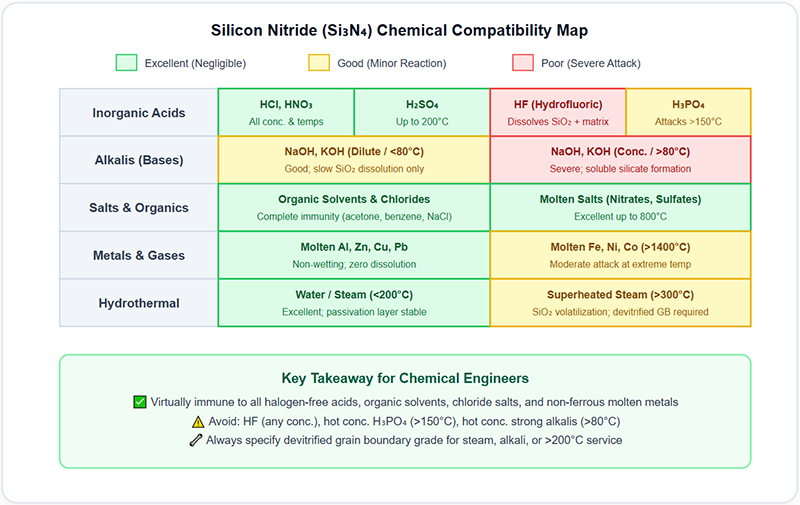
The following matrix categorizes the corrosion resistance of high-density, devitrified Si₃N₄ across common industrial chemical environments. Ratings assume GPSN-grade material with crystallized grain boundaries.
SVG Diagram 2: Si₃N₄ Chemical Resistance Compatibility Map
Critical Applications in the Chemical Processing Industry
Si₃N₄ uniquely combines exceptional chemical inertness with high fracture toughness (6-8 MPa·m½), thermal shock resistance (ΔT >800°C), and excellent tribological properties. This combination solves failure modes that plague metals, polymers, and even other ceramics like Al₂O₃ or SiC in dynamic chemical service.
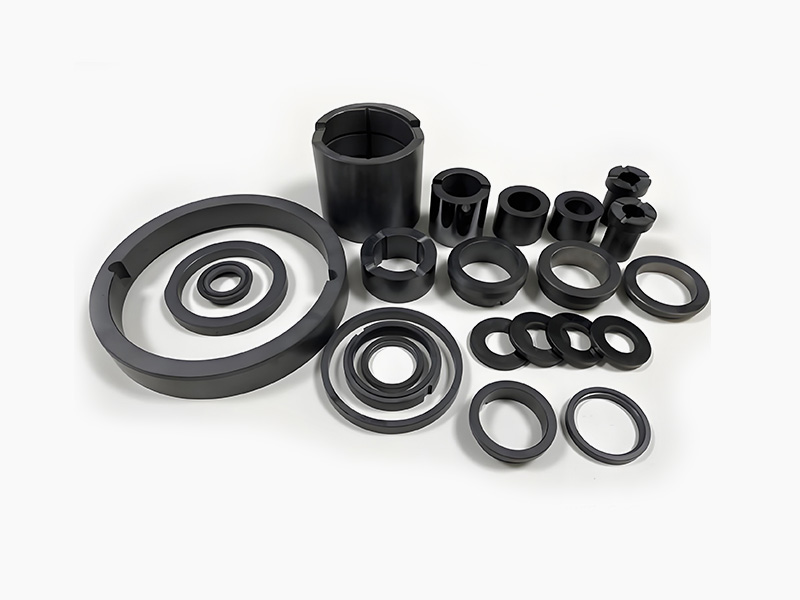
Mechanical Seal Faces & Rings
Challenge: Acidic/alkaline slurries destroy metal seals; SiC and Al₂O₃ crack during dry-run thermal shock.
Si₃N₄ Advantage: Chemical inertness + ΔT >800°C thermal shock resistance + self-lubricating behavior in aqueous media. Survives dry-running and corrosive attack simultaneously-the industry benchmark for API Plan 53A/B seal systems.
Centrifugal Pump Bearings & Shafts
Challenge: Submerged operation in H₂SO₄/HCl requires corrosion immunity + torque spike survival during startup.
Si₃N₄ Advantage: Zero corrosion in process fluid + high fracture toughness prevents shaft snapping under startup torque spikes-a common catastrophic failure mode for brittle SiC shafts.
Immersion Heaters & Thermocouple Sheaths
Challenge: Direct immersion in molten Al/Zn/Cu requires non-wetting, non-dissolving sheath material.
Si₃N₄ Advantage: Excellent non-wetting against molten non-ferrous metals. Zero dissolution ensures high-purity casting and extended heater lifespan vs. graphite or steel sheaths.
Sandblasting & Slurry Spray Nozzles
Challenge: High-velocity abrasive slurries + corrosive chemicals cause erosive-corrosive wear in WC-Co nozzles (binder leaching).
Si₃N₄ Advantage: HV 1600 hardness resists abrasion while chemical inertness prevents binder degradation. 5-10× longer life than tungsten carbide in acidic slurry service.
Valve Seats & Flow Control Balls
Challenge: Precision flow control in aggressive reagents requires maintained surface finish without pitting or galling.
Si₃N₄ Advantage: Lappable to Ra <0.01 μm mirror finish. Will not pit, gall, or corrode-ensuring leak-free shut-off in critical dosing systems handling HF-free acids and solvents.
Catalyst Supports & Reactor Linings
Challenge: High-T/P reactors need structural linings that don't act as unintended catalysts or leach metallic ions.
Si₃N₄ Advantage: Chemically inert, non-catalytic, ultra-high purity. Maintains structural integrity under severe thermal cycling and corrosive gas flows in petrochemical reforming.
Engineering Frequently Asked Questions
Q1: Why is silicon nitride highly resistant to most strong acids?
Silicon nitride's acid resistance stems from two synergistic factors: (1) The high thermodynamic stability of its covalent Si-N bonds (bond energy ~335-470 kJ/mol), which resist ionization in aqueous solutions; and (2) A self-healing passivation mechanism where exposure to oxidizing acids or water forms a dense, nanometer-thick amorphous SiO₂ surface layer. This SiO₂ film is highly insoluble in most acids (except HF) and acts as an impermeable kinetic barrier. If mechanically damaged, the fresh Si₃N₄ surface immediately re-passivates upon re-exposure.
Q2: What chemicals can corrode or dissolve silicon nitride ceramics?
Si₃N₄ is vulnerable to four specific environments: (1) Hydrofluoric acid (HF) at any concentration-dissolves both SiO₂ passivation and Si₃N₄ matrix via volatile SiF₄ formation; (2) Hot concentrated H₃PO₄ above 150°C-solvent for both SiO₂ and Si₃N₄; (3) Concentrated strong alkalis (NaOH, KOH) above 80°C-dissolve SiO₂ to form soluble silicates, enabling continuous matrix attack; (4) Molten alkali metal carbonates/hydroxides-severe grain boundary leaching. All other common industrial acids, organic solvents, and non-ferrous molten metals are fully compatible.
Q3: How does the grain boundary phase affect Si₃N₄ corrosion resistance?
Si₃N₄ requires oxide sintering additives that form an amorphous glassy oxynitride phase at grain boundaries. This glass is thermodynamically less stable and more chemically reactive than crystalline Si₃N₄ grains. In corrosive environments-especially hot alkalis and hydrothermal steam-it is selectively leached first, causing "grain fall-out." Post-sintering devitrification annealing (1400-1600°C) converts this amorphous glass into crystalline refractory silicates (e.g., Y₂Si₂O₇), dramatically improving intergranular corrosion resistance and extending service life by 5-10× in severe environments.
Q4: Why is Si₃N₄ preferred over SiC or Al₂O₃ in certain chemical applications?
Si₃N₄ uniquely combines three properties neither SiC nor Al₂O₃ offers simultaneously: (1) Superior fracture toughness (6-8 vs. 3-4 MPa·m½), preventing catastrophic failure under mechanical shock or seal misalignment; (2) Lower elastic modulus (~310 vs. ~410 GPa for SiC), providing better compliance with mating metal components and reducing contact stress; (3) Excellent thermal shock resistance (ΔT >800°C), surviving dry-run conditions and rapid thermal transients. While SiC has higher hardness and thermal conductivity, Si₃N₄'s toughness-shock-corrosion trifecta makes it irreplaceable in dynamic, thermally-cycled chemical processing equipment.