




Introduction: The Hidden Cost of Shaft Wear in Rotating Equipment
In every rotating machine - pumps, mixers, compressors, turbines, and marine propulsion systems - the interface between the rotating shaft and its supporting bushing or sleeve is one of the most stress-concentrated, wear-prone points in the entire assembly. This small annular contact zone must simultaneously support radial loads, resist abrasive particle ingress, withstand corrosive fluid attack, maintain seal face alignment, and survive thousands of hours of continuous sliding or rolling contact.
When conventional metal bushings (bronze, stainless steel, hardened steel) fail in this role, the consequences cascade: shaft scoring leads to seal leakage, which causes bearing contamination, which triggers unplanned shutdowns. Industry data shows that bushing and sleeve-related failures account for 25-35% of all rotating equipment maintenance events, with replacement costs amplified 10-20× by associated downtime, product loss, and secondary damage.
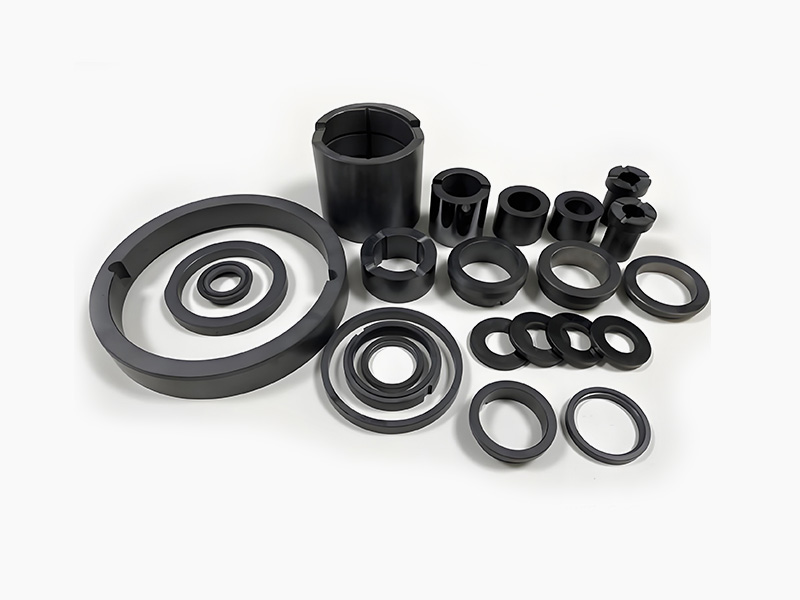
Silicon nitride (Si₃N₄) ceramic bushings and shaft sleeves represent a fundamentally different approach to shaft protection. With their unique combination of extreme hardness (HV 13-17 GPa), highest ceramic fracture toughness (KIC 6-8 MPa·m½), self-lubricating surface chemistry, and universal corrosion resistance, Si₃N₄ components transform the shaft interface from a maintenance liability into a virtually maintenance-free asset - delivering 5-10× longer service life across the world's most demanding industrial environments.
Why Si₃N₄ for Bushings and Shaft Sleeves?
Bushings and shaft sleeves operate under uniquely challenging tribological conditions that demand simultaneous performance across multiple material properties. Si₃N₄ delivers where no other material can:
Extreme Abrasion Resistance
HV 13-17 GPa Hardness
Impact-Tolerant Toughness
KIC 6-8 MPa·m½
Self-Lubricating Surface
μ = 0.05-0.15 (tribofilm)
Universal Corrosion Immunity
pH 0-14 | Seawater | Solvents| Seawater | Solvents
The Toughness Advantage Over Other Ceramics
Bushings routinely experience impact loads from shaft misalignment, startup transients, and particle ingestion. While SiC and Al₂O₃ are harder, their lower fracture toughness (3-5 MPa·m½) makes them prone to catastrophic cracking under these conditions. Si₃N₄'s 2× higher toughness provides the damage tolerance needed for reliable long-term bushing operation in real-world equipment.
Weight Reduction = Less Shaft Load
At 3.2 g/cm³, Si₃N₄ is 60% lighter than steel and 78% lighter than tungsten carbide. For high-speed rotating shafts, this weight reduction translates directly to lower centrifugal forces, reduced bearing loads, less vibration, and lower power consumption - compounding the wear-life benefit with operational efficiency gains.
How Si₃N₄ Bushings Protect Shafts - Four Wear Defense Mechanisms
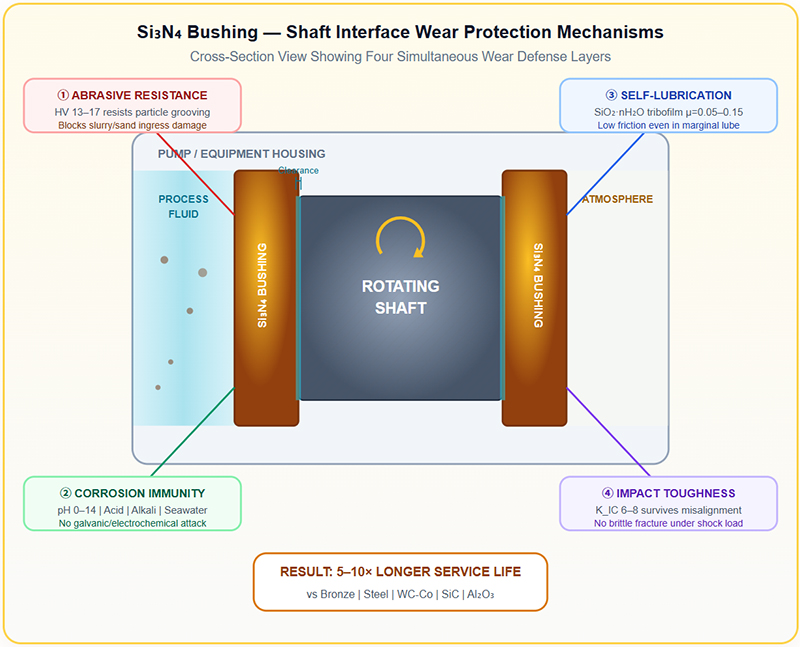
The following diagram illustrates how Si₃N₄'s material properties counter each of the four primary wear mechanisms that destroy conventional bushings at the shaft interface:
Diagram 1: Si₃N₄ Bushing - Shaft Interface Wear Protection Cross-Section
Extended Knowledge - Fretting Wear Elimination
Metal-on-metal bushing/shaft interfaces suffer fretting corrosion - microscopic oscillatory motion that generates oxide debris, accelerates wear, and eventually seizes the assembly. Si₃N₄'s chemical inertness and self-lubricating tribofilm completely eliminate fretting, enabling reliable press-fit or slip-fit installation without anti-seize compounds or specialized coatings.
Thermal Expansion Matching
Si₃N₄'s CTE of 3.2 × 10⁻⁶/°C is closer to many stainless steels (10-17 × 10⁻⁶/°C) than other ceramics. This reduces thermal mismatch stress during temperature cycling, maintaining consistent clearance and preventing the clearance closure that causes metal bushings to seize in high-temperature pump services.
Key Si₃N₄ Bushing & Sleeve Material Properties
| Property | Typical Value | Relevance to Bushings/Sleeves | Test Standard |
|---|---|---|---|
| Hardness (Vickers) | HV 13-17 GPa | Resists abrasive grooving from slurry particles | ASTM C1327 |
| Fracture Toughness (KIC) | 6-8 MPa·m½ | Survives shaft misalignment, impact, press-fit stress | ASTM C1421 |
| Flexural Strength | 700-1000 MPa | Withstands radial loads and interference fit stresses | ASTM C1161 |
| Friction Coefficient (μ) | 0.05-0.15 | Self-lubricating tribofilm reduces shaft wear | ASTM G99 |
| Thermal Conductivity | 20–30 W/m·K | Dissipates friction heat from shaft interface | ASTM C408 |
| CTE | 3.2 × 10⁻⁶/°C | Minimizes thermal mismatch with steel shafts | ASTM E228 |
| Density | 3.2 g/cm³ | 60% lighter than steel → lower centrifugal load | ASTM C373 |
| Max Service Temperature | 1400°C (inert) | Enables high-temp pump and turbine services | - |
| Dimensional Tolerance | ±0.005 mm | Ensures proper fit and seal alignment | ISO 286 |
All values for HIP/GPS sintered Si₃N₄. Properties can be tailored via microstructure engineering for specific bushing applications.
Manufacturing Process for Precision Si₃N₄ Bushings & Sleeves
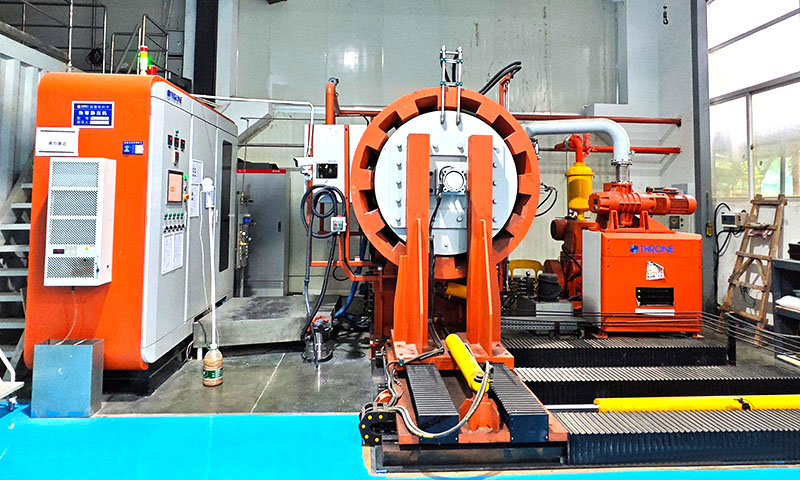
Producing bushing-grade Si₃N₄ components requires precise control over densification, grain morphology, and dimensional accuracy. The six-step manufacturing chain ensures every bushing meets exacting specifications:
Powder Blend
α-Si₃N₄ (>99.5%) + Y₂O₃/Al₂O₃. Ball-milled 24-48h. Spray-dried granules.
CIP Forming
Cold isostatic pressing 200-300 MPa into tubular green bodies. Uniform density >55% TD.
GPS/HIP Sinter
1750-1900°C, 1-10 MPa N₂ or 100-200 MPa Ar. >99.5% TD. β-grain development.
CNC Grinding
Diamond wheels (80→800 mesh). ID/OD/face grinding. Tolerance ±5μm.
Honing / Lapping
ID honing for seal-running surfaces. Ra <0.2μm. Cylindricity <2μm.
QC Inspection
CMM dimensions. Ra profilometry. Ultrasonic flaw detection. 100% check.
HIP vs GPS for Bushing Applications
For bushings subjected to high radial loads or press-fit installation, HIP sintering (100-200 MPa Ar) is preferred. HIP achieves >99.9% theoretical density with zero residual porosity, maximizing both strength and fatigue resistance. For standard sleeve applications with moderate loads, GPS provides excellent properties at lower cost. HUACIJULI offers both grades.
ID Honing - Critical for Seal Performance
When the bushing ID serves as a seal-running surface, diamond honing achieves Ra <0.2μm with controlled cross-hatch pattern that promotes hydrodynamic fluid film retention. This surface texture is essential for lip seals and mechanical seal throttle bushings to maintain lubrication and prevent dry-running damage during startup.
Si₃N₄ Bushing & Sleeve Product Range - Application Mapping
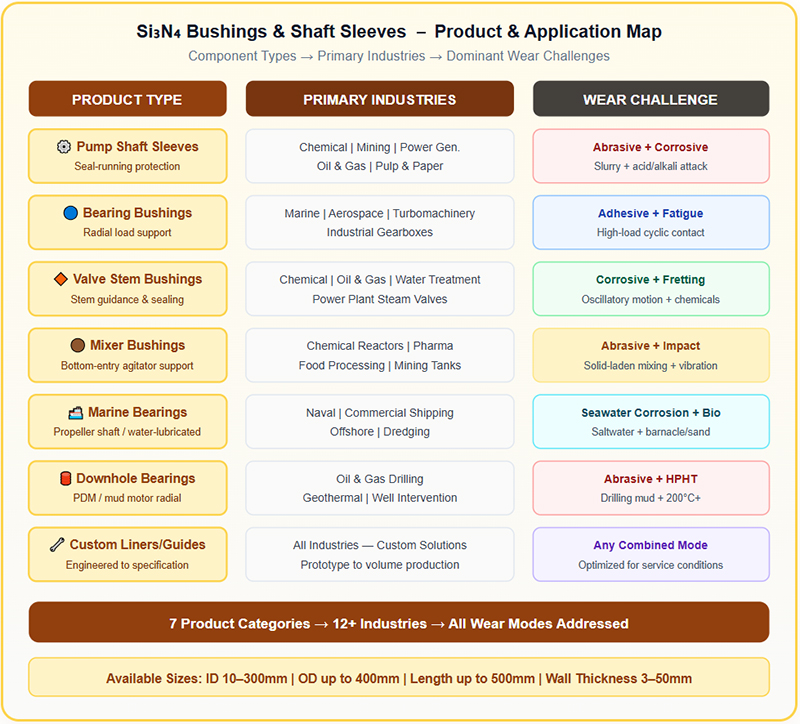
The following diagram maps our complete Si₃N₄ bushing and sleeve product range to their primary industrial applications and dominant wear challenges:
Diagram 2: Si₃N₄ Bushings & Sleeves - Product Range & Industry Map
Si₃N₄ Bushings & Sleeves - Industry Applications in Detail
Chemical Processing
Challenge: H₂SO₄, HCl, NaOH, organic solvents attacking metal shaft sleeves, causing accelerated wear and seal failure.
Si₃N₄ solution: Universal pH 0-14 immunity. Si₃N₄ shaft sleeves in API 610 chemical pumps achieve 5-8 year service life vs 6-12 months for 316SS sleeves in concentrated acid services. Eliminates shaft scoring and extends seal MTBF proportionally.
Mining & Mineral Processing
Challenge: Ore slurries with 30-60% solids eroding pump shaft sleeves and bushings within weeks.
Si₃N₄ solution: HV 13-17 GPa hardness resists abrasive grooving. Fracture toughness survives oversize particle impact. Si₃N₄ slurry pump sleeves last 12-18 months vs 4-8 weeks for hardened steel - reducing maintenance frequency by 80%.
Oil & Gas
Challenge: Sour gas (H₂S), drilling mud abrasion, downhole temperatures >200°C, high-pressure differentials.
Si₃N₄ solution: NACE MR0175 compliant (immune to sulfide stress cracking). Downhole motor bearings and valve stem bushings survive HPHT conditions that destroy elastomers and corrode metals. Critical for extended-reach and sour well completions.
Marine Propulsion
Challenge: Seawater corrosion, sand/silt abrasion, biofouling, water-lubricated stern tube bearings.
Si₃N₄ solution: Complete seawater immunity + abrasion resistance. Self-lubricating tribofilm enables reliable water-lubricated operation without oil contamination risk. Eliminates galvanic corrosion between shaft and bushing. Used in naval and commercial vessels worldwide.
Power Generation
Challenge: FGD limestone slurry, boiler feedwater at 250°C, condensate pump erosion-corrosion.
Si₃N₄ solution: Thermal shock resistance handles rapid temperature changes during plant startup/shutdown. FGD pump sleeves run 18+ months continuously. Boiler feed pump bushings maintain clearance stability at 250°C where bronze softens and seizes.
Pharmaceutical & Food
Challenge: Hygienic requirements, CIP/SIP sterilization, zero metallic contamination, FDA compliance.
Si₃N₄ solution: Biocompatible, non-toxic, FDA/USP Class VI compliant. Survives repeated 140°C steam sterilization. No metal ion leaching into product. Smooth Ra <0.2μm surface prevents bacterial adhesion and enables effective CIP cleaning.
Extended Knowledge - Total Cost of Ownership: While Si₃N₄ bushings have a higher unit cost than metal alternatives, the TCO is typically 50-70% lower over a 5-year period. A single unplanned pump shutdown in a chemical plant can cost $50,000-$200,000 in lost production. Si₃N₄ sleeves that eliminate 3-4 such events per year deliver ROI within months - making the initial premium economically trivial.
Bushing Material Comparison: Si₃N₄ vs Conventional Alternatives
| Property | Si₃N₄ | Bronze | 316SS | WC-Co | SiC | PTFE |
|---|---|---|---|---|---|---|
| Hardness (GPa) | 13-17 ★ | 1-2 | 2-3 | 13-17 | 22-28 | 0.05 |
| Fracture Toughness (MPa·m½) | 6-8 ★ | — | — | 10-15 | 3-5 | — |
| Corrosion Resistance | Excellent ★ | Moderate | Good | Poor (Co leach) | Excellent | Excellent |
| Self-Lubricating | Yes ★ | No | No | No | Limited | Yes |
| Max Temperature | 1400°C ★ | ~250°C | ~400°C | ~500°C | 1600°C | ~260°C |
| Density (g/cm³) | 3.2 ★ | 8.8 | 8.0 | 14.5 | 3.2 | 2.2 |
| Overall Bushing Score | ★★★★★ | ★★☆☆☆ | ★★☆☆☆ | ★★★☆☆ | ★★★★☆ | ★★☆☆☆ |
★ Best in category. Overall score evaluates combined performance for bushing/sleeve applications across wear, corrosion, temperature, and reliability.
Key Insight: No alternative material matches Si₃N₄'s balanced profile for bushing applications. Bronze and steel lack hardness and corrosion resistance. WC-Co corrodes due to cobalt binder leaching. SiC has higher hardness but half the fracture toughness - making it vulnerable to cracking during press-fit installation and shaft misalignment events. PTFE lacks the load capacity and temperature range. Only Si₃N₄ delivers simultaneous extreme wear resistance + impact tolerance + corrosion immunity + self-lubrication.
Why Partner With HUACIJULI for Si₃N₄ Bushings & Shafts?
Decades of Expertise
Deep Si₃N₄ materials science combined with precision cylindrical grinding mastery - optimized for bushing and sleeve performance.
±5μm Precision
CNC diamond grinding + ID honing achieving ±0.005mm tolerance, cylindricity <2μm, and Ra <0.2μm consistently across production batches.
Multiple Si₃N₄ Grades
Standard GPS, high-toughness HIP, and high-purity semiconductor grades - each optimized for specific bushing service conditions.
Full QC & Traceability
CMM dimensional verification, ultrasonic flaw detection, density certification, and full lot traceability on every shipment.
Ready to Eliminate Shaft Wear in Your Equipment?
Share your operating conditions - our engineering team will recommend the optimal Si₃N₄ bushing configuration for your application.
Contact HUACIJULI Engineering TeamFrequently Asked Questions (FAQ)
Q1: Why use Si₃N₄ ceramic bushings instead of metal?
Si₃N₄ offers 5-10× longer service life than bronze or steel in abrasive/corrosive environments. With HV 13-7 GPa hardness, KIC 6-8 MPa·m½ toughness, self-lubricating tribofilm, and pH 0-14 chemical immunity, Si₃N₄ eliminates the combined wear-corrosion failure mode that rapidly destroys metal bushings in slurry, chemical, and marine services.
Q2: What tolerances are achievable for Si₃N₄ shaft sleeves?
Standard grade: ±0.005mm (±5μm) ID/OD, cylindricity <2μm, Ra <0.2μm. Precision grade: ±0.002mm (±2μm), cylindricity <1μm, Ra <0.1μm. Concentricity between ID and OD is held to <3μm. These tolerances ensure proper interference/sliding fit and seal face alignment.
Q3: How are Si₃N₄ bushings manufactured?
Six steps: (1) Powder blending, (2) CIP forming at 200–300 MPa, (3) GPS/HIP sintering at 1750-1900°C for >99.5% density, (4) CNC diamond grinding of ID/OD/faces to ±5μm, (5) ID honing/lapping for seal-grade finish, (6) 100% QC inspection including CMM, profilometry, and ultrasonic testing.
Q4: Which industries use Si₃N₄ bushings and sleeves?
Chemical (acid/alkali pump sleeves), mining (slurry pump bushings), oil & gas (downhole bearings, valve stems), marine (propulsion shaft bearings), power generation (FGD, boiler feed), pulp & paper (bleach pumps), and pharma/food (hygienic pump bushings). Si₃N₄ excels wherever combined abrasive, corrosive, and thermal challenges exist.
Q5: How does Si₃N₄ compare to SiC for bushing applications?
SiC has higher hardness (22-28 vs 13-17 GPa) but significantly lower fracture toughness (3-5 vs 6-8 MPa·m½). For bushings that experience press-fit installation stresses, shaft misalignment, and particle impact, SiC's brittleness leads to cracking failures. Si₃N₄'s 2× higher toughness provides the damage tolerance essential for reliable bushing operation, making it the superior choice despite slightly lower hardness.