




Introduction: The $10 Billion Cost of Pump and Valve Seal Failures
Mechanical seals are the most common point of failure in rotating equipment and valve systems worldwide. Industry data from the Hydraulic Institute and API indicates that seal failures account for approximately 40-60% of all pump maintenance events and represent an estimated global cost of $10–15 billion annually in unplanned downtime, product loss, environmental cleanup, and replacement components.
The root cause of most seal failures lies in the extreme operating environment at the seal face interface: PV values exceeding 15 MPa·m/s, sliding velocities up to 30 m/s, process temperatures from cryogenic to 300°C+, and contact with aggressive chemicals, abrasive slurries, and high-pressure gases. Conventional seal face materials - carbon-graphite, tungsten carbide, alumina, and reaction-bonded SiC - each come with fundamental limitations that lead to predictable failure modes in demanding services.
Silicon nitride (Si₃N₄) ceramics represent a transformative advance in seal face technology. With its unique combination of highest fracture toughness (KIC 6-8 MPa·m½), self-lubricating tribofilm formation, exceptional chemical resistance, and thermal shock immunity, Si₃N₄ enables mechanical seals to achieve mean-time-between-failure (MTBF) improvements of 3-5× in the world's most demanding pump and valve services. This technical guide explores the complete engineering case for Si₃N₄ ceramic seals.
Why Si₃N₄ for Pump and Valve Seals?
A mechanical seal's performance is fundamentally determined by its seal face materials. Si₃N₄ delivers simultaneous advantages across every critical performance dimension required for reliable sealing:
Highest Ceramic Toughness
KIC 6-8 MPa·m½
Seal-Grade Hardness
HV 13-17 GPa
Self-Lubricating
μ = 0.05-0.15 (tribofilm)
Chemical Resistance
pH 0-14 | Most solvents| Most solvents
The Si₃N₄ Toughness Advantage
Seal face materials routinely experience impact loads from pressure surges, dry running, and particle ingestion. SiC and Al₂O₃ (KIC 3-5 MPa·m½) fracture catastrophically under these conditions. Si₃N₄'s 2× higher toughness enables it to survive pressure transients, water hammer, and accidental dry running that destroy other ceramic seal faces.
Self-Generated Lubricating Film
Under sliding contact in aqueous environments, Si₃N₄ reacts with water to form a thin silica gel tribofilm (SiO₂·nH₂O) at the seal face interface. This self-generated lubricating layer reduces friction to μ ≈ 0.05-0.15 - enabling low-wear operation even during startup, shutdown, and marginal lubrication conditions.
Mechanical Seal Face Contact Mechanics - How Si₃N₄ Seals Work
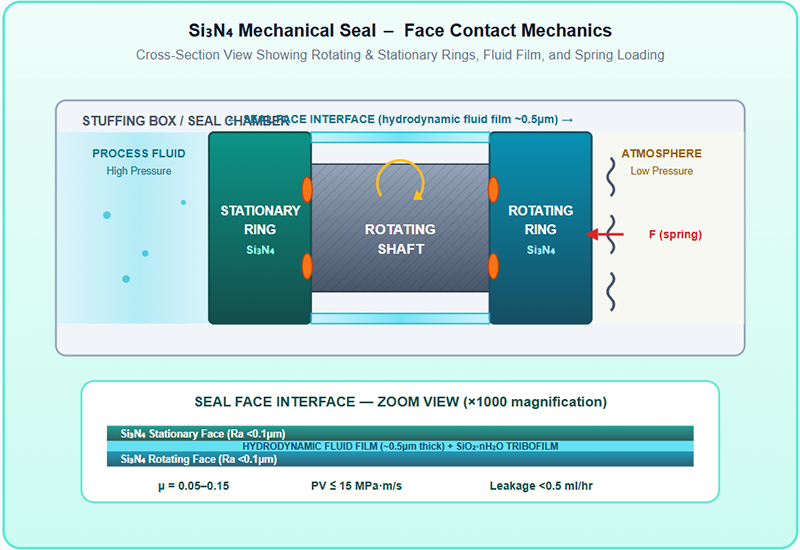
Understanding the tribology at the seal face interface is essential to appreciating why Si₃N₄ outperforms all other seal face materials. The following diagram illustrates the critical contact mechanics of a Si₃N₄ mechanical seal under operating conditions:
Diagram 1: Si₃N₄ Mechanical Seal - Face Contact Mechanics Cross-Section
The Hydrodynamic Fluid Film
In properly designed mechanical seals, the rotating ring generates a thin hydrodynamic fluid film (~0.3-1.0μm) at the seal face interface. This film carries the load, preventing direct solid contact between the faces. Si₃N₄'s mirror finish (Ra <0.1μm) and self-generated tribofilm maintain this film stability even under marginal lubrication conditions - preventing face contact and extending seal life.
PV Value Capability
The PV value (contact pressure × sliding velocity) is the primary performance metric for seal face materials. Si₃N₄ achieves PV limits of 12-15 MPa·m/s - approximately 2× higher than SiC (6–8 MPa·m/s) and 3-5× higher than carbon-graphite or tungsten carbide. This enables Si₃N₄ seals to operate reliably in high-pressure, high-speed services where other materials would suffer thermal cracking or catastrophic failure.
Key Si₃N₄ Seal Material Properties
| Property | Typical Value | Relevance to Sealing | Test Standard |
|---|---|---|---|
| Fracture Toughness (KIC) | 6-8 MPa·m½ | Survives pressure surges, dry running, particle impact | ASTM C1421 |
| Hardness (Vickers) | HV 13-17 GPa | Resists abrasive wear from process particles | ASTM C1327 |
| Flexural Strength | 700-1000 MPa | Withstands spring loading and pressure differential | ASTM C1161 |
| Friction Coefficient (μ) | 0.05-0.15 | Low heat generation at seal face interface | ASTM G99 |
| Thermal Conductivity | 20-30 W/m·K | Dissipates friction heat from seal faces | ASTM C408 |
| CTE | 3.2 × 10⁻⁶/°C | Matches metal housings; maintains face flatness | ASTM E228 |
| Thermal Shock Resistance | ΔT >800°C | Survives cold fluid injection into hot seals | ASTM C1525 |
| Max Service Temperature | 1400°C (inert) | Enables high-temp hydrocarbon services | — |
| Seal Face Surface Finish | Ra <0.1μm | Enables hydrodynamic film formation | ISO 4287 |
All values for GPS/HIP sintered Si₃N₄. Properties can be tailored via microstructure engineering for specific seal applications.
Manufacturing Process for Si₃N₄ Seal Rings
Producing seal-grade Si₃N₄ rings requires exceptional control over microstructure, density, and surface finish. The manufacturing chain includes six critical stages:
Powder Blend
High-purity α-Si₃N₄ (>99.5%) + Y₂O₃/Al₂O₃ additives, ball-milled 24-48h.
CIP Forming
Cold isostatic pressing at 200-300 MPa into seal ring green shapes.
GPS/HIP Sintering
1750-1900°C, 1-10 MPa N₂. >99.5% TD. Controlled β-grain growth.
CNC Grinding
Diamond wheels (80→800 mesh). OD/ID/face grinding to ±5μm.
Lapping & Polish
SiC/diamond lapping. Final Ra <0.1μm. Flatness <1 light band.
QC Inspection
Optical flat testing. Ra profilometry. 100% visual + dimensional check.
Flatness - The Seal's Most Critical Dimension
Seal face flatness is measured in light bands using an optical flat and monochromatic light. One light band ≈ 0.3μm deviation. Seal-grade Si₃N₄ faces achieve <1 light band flatness across the entire sealing width - this is essential for maintaining a continuous hydrodynamic fluid film and preventing leak paths. Any deviation creates direct face contact, rapid wear, and leakage.
HIP vs GPS for Seal Rings
For seal applications, HIP sintering (Hot Isostatic Pressing at 100-200 MPa Ar) is preferred over GPS. HIP achieves >99.9% theoretical density with zero residual porosity - essential for preventing fluid permeation through the seal face and ensuring a hermetic sealing surface. HIP also produces more uniform grain size for predictable lapping behavior.
Si₃N₄ Seal Configurations - API 682 Standard Arrangements
Si₃N₄ seal rings can be specified in multiple configurations depending on the service severity, safety requirements, and environmental regulations. The following diagram maps the four primary API 682 seal arrangements to their typical industrial applications:
Diagram 2: Si₃N₄ Seal Configurations - API 682 Arrangements & Applications
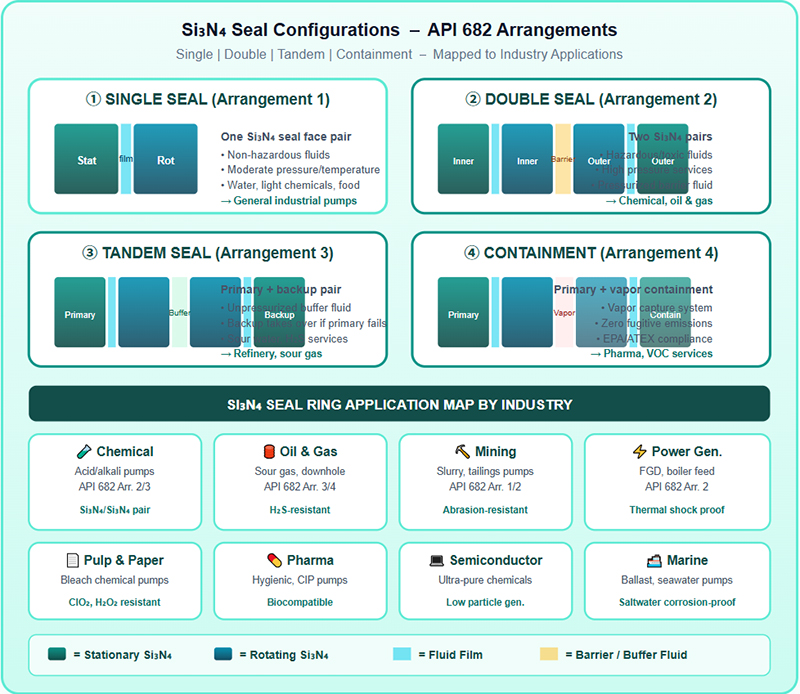
Extended Knowledge - Si₃N₄/Carbon vs Si₃N₄/Si₃N₄ Pairs: For aqueous services, Si₃N₄ rotating rings paired with antimony-impregnated carbon-graphite stationary faces provide the lowest friction and best dry-run capability. For non-lubricating solvents, hot hydrocarbons, or corrosive slurries, Si₃N₄/Si₃N₄ pairs are preferred because both faces benefit from the tribofilm self-lubrication mechanism and neither face is chemically attacked. HUACIJULI supplies both configurations.
Si₃N₄ Seal Applications - Industry by Industry
Each industry presents unique sealing challenges that Si₃N₄ is uniquely qualified to address:
Chemical Processing
Seal challenge: Sulfuric acid (98%), HCl, NaOH, organic solvents, mixed acid services. pH range 0-14.
Si₃N₄ advantage: Near-universal chemical resistance. Si₃N₄/Si₃N₄ pairs in API 682 Arrangement 2 double seals achieve 5-8 year MTBF vs 6-12 months for conventional SiC/carbon pairs in strong acid services.
Oil & Gas / Refining
Seal challenge: Sour water (H₂S), amine solutions, hot hydrocarbons, high-pressure gas, downhole brines.
Si₃N₄ advantage: Immunity to H₂S attack (critical for NACE MR0175 sour service), thermal shock resistance during gas decompression, and high PV capability for high-pressure gas seals.
Mining & Mineral Processing
Seal challenge: Abrasive ore slurries (30-60% solids), tailings pumps, high-velocity particle impact.
Si₃N₄ advantage: HV 13-17 GPa hardness resists abrasive grooving. Fracture toughness (6-8 MPa·m½) prevents impact chipping from oversize particles. 3-5× longer seal life vs tungsten carbide in slurry services.
Power Generation
Seal challenge: FGD limestone slurry, boiler feedwater at 250°C, condensate pumps, cooling water.
Si₃N₄ advantage: Thermal shock resistance handles rapid temperature changes during plant startup/shutdown. FGD slurry pumps with Si₃N₄ seals run 18+ months vs 4-6 months for conventional seals.
Pulp & Paper
Seal challenge: Chlorine dioxide (ClO₂), hydrogen peroxide (H₂O₂), black liquor, caustic white liquor.
Si₃N₄ advantage: Immunity to aggressive oxidizers that attack metals and carbon-graphite faces. Si₃N₄ bleach plant pump seals eliminate the #1 cause of unplanned downtime in pulp mills.
Pharmaceutical & Food
Seal challenge: Hygienic requirements, CIP/SIP sterilization at 140°C, zero product contamination.
Si₃N₄ advantage: Biocompatible, non-toxic, FDA/USP Class VI compliant. Survives repeated steam sterilization cycles. No carbon particle contamination of product.
Extended Knowledge - Fugitive Emissions Compliance: Environmental regulations (EPA Method 21, EU IED, ATEX) require pumps handling VOCs to maintain fugitive emissions below 100 ppm. Si₃N₄ double and containment seals consistently achieve <10 ppm emissions, enabling plants to meet the most stringent environmental standards without expensive vapor recovery systems.
Seal Face Material Comparison: Si₃N₄ vs Alternatives
| Property | Si₃N₄ | SiC (SSiC) | Al₂O₃ | WC-Co | Carbon-Graphite | Stellite 6 |
|---|---|---|---|---|---|---|
| Fracture Toughness (MPa·m½) | 6-8 ★ | 3-5 | 3-5 | 10-15 | - | - |
| Hardness (GPa) | 13-17 | 22-28 ★ | 15-20 | 13-17 | 1-3 | 5-7 |
| Friction (μ in water) | 0.05-0.15 ★ | 0.1-0.3 | 0.2-0.5 | 0.2-0.4 | 0.05-0.2 | 0.3-0.6 |
| PV Limit (MPa·m/s) | 12-15 ★ | 6-8 | 3-5 | 3-5 | 2-4 | 2-3 |
| Corrosion (pH range) | 0-14 ★ | 1-13 | 3-12 | Poor (Co leach) | Limited | Good |
| Thermal Shock | Excellent ★ | Good | Moderate | Good | Poor | Good |
| Overall Seal Score | ★★★★★ | ★★★★☆ | ★★★☆☆ | ★★☆☆☆ | ★★☆☆☆ | ★★☆☆☆ |
★ Best in category. Overall Seal Score evaluates combined performance across toughness, wear, friction, corrosion, and thermal shock for pump/valve sealing applications.
Key Insight - The Si₃N₄ vs SiC Decision: SiC is often specified as the "default" ceramic seal face material. However, SiC's lower fracture toughness (3-5 vs 6-8 MPa·m½) makes it vulnerable to catastrophic failure under pressure surges, particle impact, and dry running - precisely the conditions that occur in real-world pump operations. Si₃N₄'s 2× higher toughness provides the safety margin that prevents these catastrophic failures, making it the superior choice for critical services despite a slightly higher initial cost.
Why Partner With HUACIJULI for Si₃N₄ Pump & Valve Seals?
Seal-Grade Expertise
Decades of Si₃N₄ research combined with precision seal face manufacturing - optimized microstructure specifically for mechanical sealing performance.
Sub-0.1μm Surface Finish
Proprietary lapping and polishing process achieving Ra <0.05μm and flatness <1 light band consistently across production batches.
API 682 Compliance
Seal rings manufactured to API 682, ISO 21049, and EN 12756 dimensional standards. Standard sizes 20–200mm shaft diameter + full custom capability.
100% Metrology Inspection
Every seal face inspected for flatness (optical flat), surface roughness (profilometer), dimensions (CMM), and visual defects before shipment.
Ready to Eliminate Pump Seal Failures?
Share your process conditions - our seal engineering team will recommend the optimal Si₃N₄ seal configuration for your application.
Contact HUACIJULI Seal Engineering TeamFrequently Asked Questions (FAQ)
Q1: Why is silicon nitride used for pump and valve seals?
Si₃N₄ uniquely combines the highest fracture toughness (KIC 6-8 MPa·m½) among engineering ceramics, self-lubricating tribofilm formation (μ 0.05-0.15), universal chemical resistance (pH 0-14), and thermal stability to 1400°C. This enables Si₃N₄ seal faces to survive pressure surges, dry running, particle impact, and corrosive fluids that destroy conventional seal materials.
Q2: What types of Si₃N₄ seal components are available?
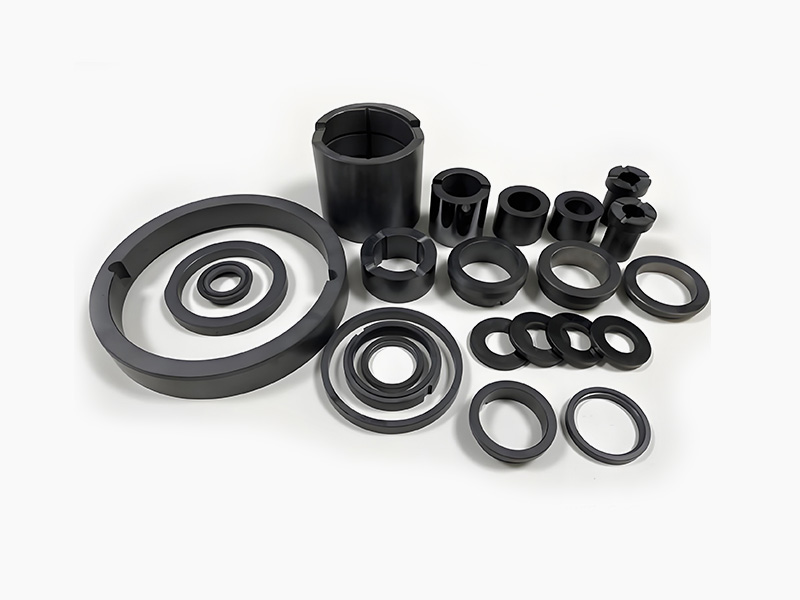
We manufacture rotating seal faces, stationary seal rings, shaft sleeves, throttle bushings, and complete seal face pairs in standard sizes (20-200mm shaft diameter) and custom configurations meeting API 682, ISO 21049, and EN 12756 standards. Both Si₃N₄/Si₃N₄ and Si₃N₄/carbon-graphite pairs are available.
Q3: What surface finish is required for mechanical seal faces?
Seal-grade Si₃N₄ faces require Ra <0.1μm (typically 0.02-0.05μm) mirror finish and flatness <1 light band (~0.3μm) across the sealing width. This precision is achieved via multi-stage lapping with progressively finer diamond/SiC abrasives, followed by final polishing. The finish ensures hydrodynamic fluid film formation and prevents leakage paths.
Q4: Which industries benefit most from Si₃N₄ seals?
Chemical processing (acid/alkali pumps), oil & gas (sour gas, H₂S services), mining (abrasive slurry pumps), power generation (FGD, boiler feed), pulp & paper (bleach chemicals), pharmaceutical (hygienic CIP pumps), and semiconductor (ultra-pure chemical transfer). Si₃N₄ excels wherever seals face combined corrosive, abrasive, and thermal cycling conditions.
Q5: How does Si₃N₄ compare to SiC for seal face applications?
SiC has higher hardness (22-28 vs 13-17 GPa) but lower fracture toughness (3-5 vs 6-8 MPa·m½). In real-world seal services with pressure surges, particle impact, and dry-running events, SiC faces suffer catastrophic brittle fracture while Si₃N₄ faces survive. Si₃N₄ also offers lower friction (μ 0.05-0.15 vs 0.1-0.3) via tribofilm formation and 2× higher PV capability (12-15 vs 6-8 MPa·m/s), making it superior for critical and high-severity services.