




The Hybrid Bearing Revolution: Why Replace Steel Balls?
For over a century, AISI 52100 chrome steel has been the default rolling element material for bearings. But as modern machinery demands higher speeds, higher temperatures, electrical isolation, and longer maintenance intervals, steel has reached its fundamental physical limits. Enter Silicon Nitride (Si₃N₄) - an advanced ceramic that doesn't just incrementally improve bearing performance, but fundamentally redefines what's possible.
A hybrid bearing combines Si₃N₄ ceramic balls with conventional steel races. This configuration captures the best of both worlds: the extreme hardness, low density, and electrical insulation of ceramic, paired with the toughness, ductility, and cost-effectiveness of steel. Today, hybrid Si₃N₄ bearings are the standard solution in EV traction motors, machine tool spindles, aerospace turbines, and wind generators - solving failure modes that steel simply cannot address.
Key Material Properties of Si₃N₄ Bearing Balls
| Property | Si₃N₄ Value | Steel (52100) | Bearing Performance Impact |
|---|---|---|---|
| Density | 3.2 g/cm³ | 7.8 g/cm³ | 60% lighter → lower centrifugal force at speed |
| Hardness (HV) | 1600-1800 | 700-800 | 2× harder → resists debris denting & surface fatigue |
| Elastic Modulus | 310 GPa | 210 GPa | Higher stiffness → smaller contact ellipse, less sliding |
| Electrical Resistivity | >10¹⁴ Ω·cm | ~10⁻⁶ Ω·cm | Perfect insulator → eliminates EDM/fluting damage |
| CTE | 3.2 × 10⁻⁶/°C | 12 × 10⁻⁶/°C | Lower expansion → stable preload at high temperature |
| Max Operating Temp | 1000°C+ | ~150°C | Enables operation where steel loses hardness |
The Physics of Speed: Centrifugal Load Reduction
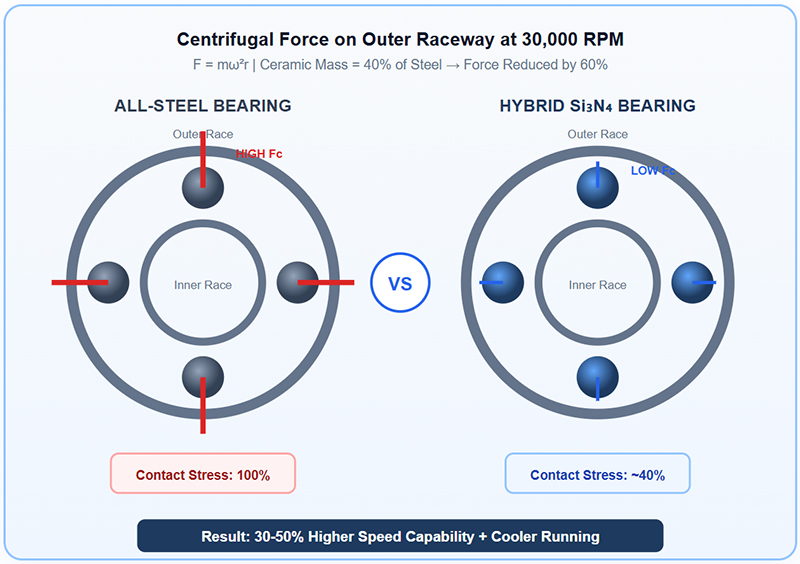
The single most transformative advantage of Si₃N₄ balls is their 60% lower density. At high rotational speeds, centrifugal force (F = mω²r) becomes the dominant load on the outer raceway. The following diagram illustrates how ceramic balls dramatically reduce this parasitic loading:
Diagram 1: Centrifugal Force Comparison - Steel vs Si₃N₄ Balls at High RPM
Extended Knowledge: DN Value
Bearing speed limit is expressed as DN value (bore diameter mm × RPM). Standard steel angular contact bearings max out at ~500,000 DN. Hybrid Si₃N₄ bearings routinely achieve 750,000-1,000,000+ DN, enabling machine tool spindles to reach 60,000+ RPM for precision micro-machining.
Secondary Benefit: Reduced Heat Generation
Lower centrifugal force means less friction between balls and the outer raceway. This reduces bearing operating temperature by 10-20°C at high speeds, preserving grease/lubricant life and preventing thermal preload increase that can cause seizure in preloaded spindle bearings.
6 Ways Si₃N₄ Balls Enhance Bearing Performance
1. Higher Speed Capability
60% lower mass reduces centrifugal loading on the outer race by up to 60%. This enables 30–50% higher RPM limits while maintaining acceptable contact stresses and lubricant film integrity. Critical for spindles, turbos, and EV motors.
2. Electrical Insulation (EDM Prevention)
Si₃N₄ is a perfect insulator (>10¹⁴ Ω·cm). In VFD-driven motors, it completely blocks shaft currents from passing through the bearing, eliminating electrical discharge machining (EDM) pitting and fluting - the #1 premature failure mode in EV and industrial motor bearings.
3. Extended Fatigue Life
Under clean, well-lubricated conditions, hybrid bearings achieve 3-10× longer L10 fatigue life vs all-steel. Higher hardness resists subsurface crack initiation, lower centrifugal force reduces cyclic stress amplitude, and smoother ceramic surfaces promote better EHL film formation.
4. Debris Denting Resistance
In contaminated lubricants, hard particles create dents in steel raceways that become fatigue initiation sites. Si₃N₄ balls (HV 1700) are 2× harder than steel races, so they resist denting and actually "roll over" debris without creating stress concentrations, dramatically extending life in dirty environments.
5. Thermal Stability & Preload Control
Si₃N₄'s CTE (3.2 ppm/K) is ¼ that of steel. As bearings heat up during operation, steel balls expand more than ceramic balls would. In preloaded spindle pairs, this means hybrid bearings maintain more consistent preload across temperature ranges, preventing both looseness (vibration) and over-preload (seizure).
6. Marginal Lubrication Survival
Si₃N₄ has a lower coefficient of friction against steel than steel-on-steel. Combined with its chemical inertness and ability to form protective tribofilms, hybrid bearings can survive brief oil starvation events and boundary lubrication conditions that would cause immediate scuffing in all-steel bearings.
Si₃N₄ Bearing Balls Across Industries
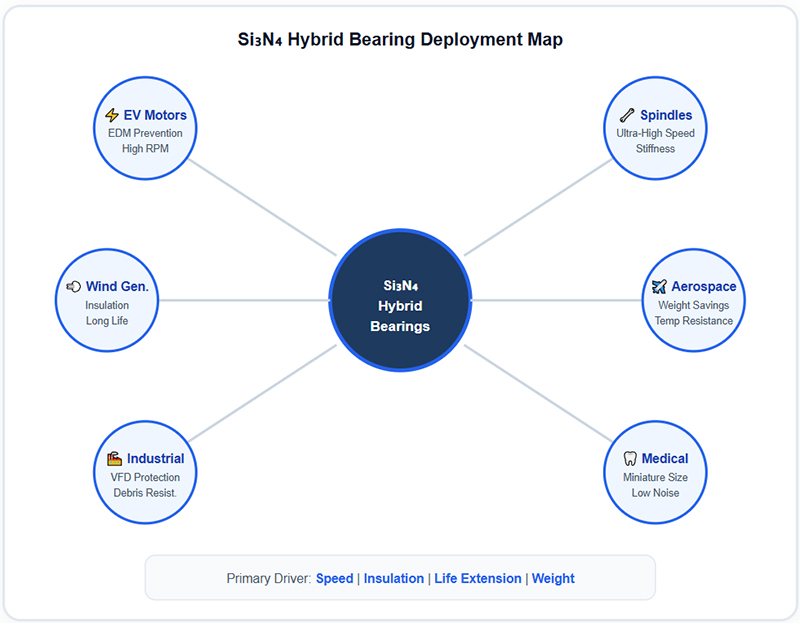
The following diagram maps the primary industrial applications of Si₃N₄ hybrid bearings to their dominant performance requirements:
Diagram 2: Si₃N₄ Hybrid Bearing Application Matrix
EV Traction Motors
Modern EV motors spin at 15,000-25,000 RPM with VFD-induced shaft voltages. Si₃N₄ hybrid bearings are now OEM standard in Tesla, BYD, and European EV platforms, eliminating EDM fluting and enabling higher power density motor designs.
Machine Tool Spindles
High-speed machining centers require 20,000-60,000 RPM spindles with micron-level runout. Si₃N₄ balls enable these speeds while maintaining stable preload and low vibration, achieving surface finishes impossible with steel bearings.
Wind Turbine Generators
Direct-drive wind generators produce significant stray currents. Si₃N₄ insulated bearings prevent electrical erosion in main shaft and generator bearings, extending service intervals from 2 years to 5+ years in offshore installations where maintenance costs exceed $100K per event.
All-Steel vs Hybrid Si₃N₄ Bearing Performance
| Performance Metric | All-Steel | Hybrid Si₃N₄ | Improvement |
|---|---|---|---|
| Max Speed (DN Value) | ~500,000 | 750,000-1,000,000+ | +50-100% |
| Fatigue Life (L10) | Baseline | 3-10× Baseline | +200-900% |
| EDM / Fluting Resistance | None | Complete Immunity | ∞ |
| Operating Temperature Rise | Baseline | -10 to -20°C | Cooler Running |
| Debris Denting Resistance | Moderate | Excellent | Significant |
| Unit Cost | $ | $$$ | Higher Initial |
Note: While hybrid bearings have higher unit cost, Total Cost of Ownership (TCO) is typically 40-60% lower in demanding applications due to extended replacement intervals, reduced downtime, and prevented secondary damage.
Why Partner With HUACIJULI for Si₃N₄ Bearing Balls?
Precision Grades G3-G10
ISO 3290 compliant ceramic balls with sphericity ≤0.08μm (G3), surface roughness Ra<0.01μm, and lot size variation ≤0.1μm for ultra-precision spindle and aerospace applications.
HIP-Sintered Microstructure
Hot Isostatic Pressing eliminates residual porosity, achieving >99.9% theoretical density. Zero pores = zero subsurface fatigue initiation sites = maximum rolling contact fatigue life.
100% NDT Inspection
Every production lot undergoes ultrasonic flaw detection, eddy current testing, and optical surface inspection to guarantee zero critical defects before shipment to bearing manufacturers.
Engineering Next-Generation Bearing Performance?
From prototype samples to million-ball production runs, our tribology team supports your hybrid bearing development from concept to qualification.
Request Si₃N₄ Ball Samples & Technical DataFrequently Asked Questions (FAQ)
Q1: How much faster can hybrid ceramic bearings run vs steel?
Hybrid Si₃N₄ bearings typically achieve 30-50% higher speed limits (DN value) than equivalent all-steel bearings. In some optimized spindle designs, speed improvements exceed 100%. The exact gain depends on bearing type, preload, lubrication, and cooling system design.
Q2: Will ceramic balls damage the steel races?
No. Despite being 2× harder than steel, Si₃N₄ balls actually reduce raceway wear due to lower friction, reduced centrifugal loading, and superior EHL film formation. Decades of field data confirm that hybrid bearings do not accelerate race fatigue when properly designed and lubricated.
Q3: Are hybrid bearings suitable for heavy-load applications?
Hybrid bearings excel in high-speed, moderate-load applications. For very heavy static or shock loads, all-steel bearings may be preferred due to steel's higher fracture toughness. However, modern HIP-sintered Si₃N₄ (KIC 6-8 MPa·m½) has sufficient toughness for most industrial and automotive dynamic loading conditions.
Q4: What lubrication works best with Si₃N₄ ceramic balls?
Si₃N₄ is compatible with all standard bearing lubricants: mineral oils, PAO synthetics, greases, and even water-based fluids. No special lubricant formulation is required. In fact, hybrid bearings often perform better with thinner lubricants due to improved EHL film formation on the smoother ceramic surface.