






Introduction: Why Precision Si₃N₄ Plates and Discs Matter
In advanced manufacturing, the performance of entire systems often hinges on flat, dimensionally stable ceramic components measured in micrometers. Semiconductor wafer carriers must maintain sub-micrometer flatness across 300mm diameters to ensure lithographic alignment. EV power module substrates require perfect thermal conductivity matching with copper layers while providing electrical isolation. Aerospace turbine shrouds demand dimensional stability at 1200°C+ under centrifugal loading.
Silicon nitride (Si₃N₄) ceramic plates and discs have become the material of choice for these mission-critical applications because they uniquely combine high strength (700-1000 MPa), exceptional fracture toughness (6-8 MPa·m½), low thermal expansion (3.2 × 10⁻⁶/°C), excellent thermal shock resistance, and outstanding electrical insulation - properties no metal, polymer, or other ceramic can deliver simultaneously.
However, achieving these properties in finished plate and disc form requires precise control over every manufacturing step - from powder chemistry and sintering parameters to diamond grinding and final polishing. This technical guide details the complete precision processing chain that transforms raw Si₃N₄ powder into finished components meeting the world's most demanding specifications.
Material Composition of Si₃N₄ Ceramic Plates and Discs
The performance of finished Si₃N₄ plates and discs is fundamentally determined by their chemical composition and resulting microstructure. Understanding this relationship is essential for specifying the right material grade for each application.
Primary Phase: β-Si₃N₄ (>90%)
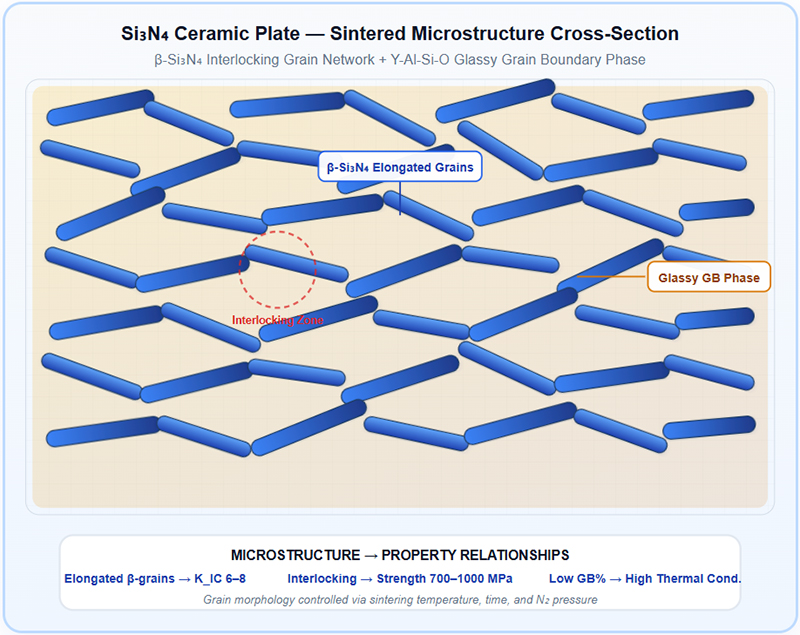
The starting α-Si₃N₄ powder undergoes solution-reprecipitation transformation during sintering to form elongated β-Si₃N₄ grains. These needle-like crystals (aspect ratio 5-10:1) interlock to create a self-reinforcing microstructure responsible for Si₃N₄'s exceptional toughness.
Sintering Additives (4-8 wt%)
Y₂O₃ (3-6%) and Al₂O₃ (1-3%) are the primary sintering aids. They react with native SiO₂ on powder surfaces to form a liquid yttrium-aluminum-silicate phase that enables densification via liquid-phase sintering and controls β-grain growth kinetics.
Grain Boundary Phase (2-5%)
After sintering, residual glassy or crystalline intergranular phase remains at grain boundaries. Its composition and volume fraction critically affect high-temperature creep resistance, thermal conductivity, and corrosion resistance. Post-sintering annealing can crystallize this phase for improved high-T performance.
Extended Knowledge - Composition-Property Relationships
Higher Y₂O₃/Al₂O₃ ratios promote more complete β-transformation and larger grain aspect ratios → higher toughness but lower strength. Lower additive levels produce finer grains → higher strength and hardness but reduced toughness. For semiconductor substrates, ultra-high purity (>99.9%) with minimal glassy phase maximizes thermal conductivity and plasma erosion resistance. For structural plates, optimized additive levels balance toughness and machinability. HUACIJULI offers multiple Si₃N₄ grades tailored to specific plate/disc application requirements.
Si₃N₄ Plate Microstructure - The Foundation of Performance
The following diagram illustrates the characteristic microstructure of sintered Si₃N₄ ceramic plates, showing the interlocking β-grain network and grain boundary phase that determine mechanical, thermal, and electrical properties:
Diagram 1: Si₃N₄ Ceramic Plate Cross-Section Microstructure
Manufacturing Process for Precision Si₃N₄ Plates and Discs
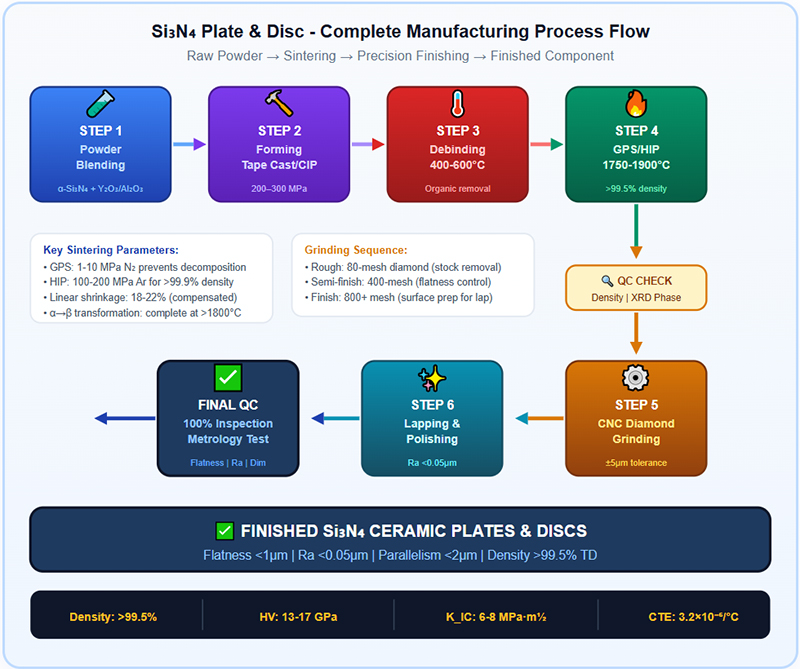
Producing Si₃N₄ plates and discs to sub-micrometer precision requires a tightly controlled six-step manufacturing chain. Each step directly influences the final dimensional accuracy, surface quality, and material properties:
Powder Blending
α-Si₃N₄ (>99.5%) + Y₂O₃/Al₂O₃. Wet ball milling 24-48h. Spray drying for granulation.
Forming
Tape casting (thin plates) or CIP at 200-300 MPa (thick plates/discs). Green machining to near-net shape.
Debinding
Controlled thermal debinding 400-600°C. Slow ramp rates prevent cracking in thick sections.
GPS / HIP Sintering
1750-1900°C, 1-10 MPa N₂. α→β transformation. >99.5% TD. Controlled shrinkage ~18-22%.
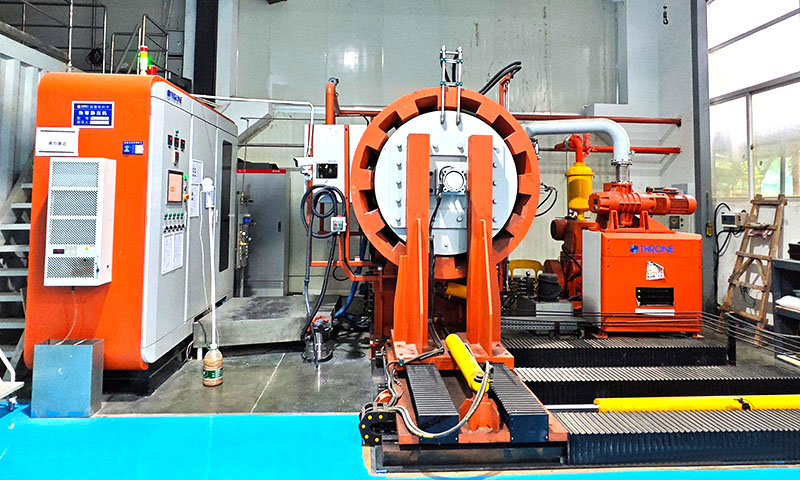
CNC Grinding
Diamond wheels (80→400→800 mesh). Double-disc grinding for parallelism. Tolerance ±5μm.
Lapping & Polishing
SiC/diamond slurry lapping. CMP polishing. Final Ra <0.05μm. Flatness <1μm/100mm.
Tape Casting vs CIP Forming
Tape casting is preferred for thin plates (<2mm) and large-area substrates, producing uniform thickness with excellent green density homogeneity. Cold isostatic pressing (CIP) is used for thicker plates (>3mm) and discs, providing isotropic compaction and superior green strength for subsequent machining. Both methods achieve green densities >55% TD necessary for defect-free sintering.
Shrinkage Compensation
Si₃N₄ undergoes 18-22% linear shrinkage during sintering. Precise shrinkage prediction (via statistical process control across production batches) allows green parts to be oversized so that sintered dimensions fall within ±0.1mm - minimizing post-sinter machining time and cost. HUACIJULI maintains shrinkage variation within ±0.3% batch-to-batch.
Complete Manufacturing Process Flow
The following diagram visualizes the end-to-end production flow from raw powder to finished precision Si₃N₄ plate/disc, including key process parameters and quality checkpoints at each stage:
Diagram 2: Si₃N₄ Plate & Disc Manufacturing Process Flow
Achievable Precision Specifications
Xiamen HUACIJULI's precision processing capabilities for Si₃N₄ plates and discs span three tiers, from standard industrial grade to ultra-precision semiconductor grade:
| Specification | Standard Grade | Precision Grade | Ultra-Precision (Semi) |
|---|---|---|---|
| Dimensional Tolerance | ±0.02 mm | ±0.005 mm | ±0.002 mm ★ |
| Flatness (per 100mm) | <5 μm | <2 μm | <1 μm ★ |
| Parallelism | <10 μm | <5 μm | <2 μm ★ |
| Surface Roughness (Ra) | <0.4 μm | <0.1 μm | <0.05 μm ★ |
| Thickness Uniformity | ±0.05 mm | ±0.02 mm | ±0.005 mm ★ |
| Edge Quality | Chamfered | Ground radius | Polished edge ★ |
| Typical Applications | Industrial wear plates, seal faces | Aerospace, EV substrates | Semiconductor, optics |
★ Best achievable specification. Custom intermediate grades available upon request.
Industry Applications of Precision Si₃N₄ Plates and Discs
Semiconductor Manufacturing
Components: Wafer carriers (FOUP), focus rings, etch chamber liners, CMP retaining rings, heater covers.
Why Si₃N₄: Ultra-low particle generation, plasma erosion resistance 5× better than quartz, CTE matched to silicon wafers, and electrical insulation preventing arcing in plasma chambers.
EV Power Electronics
Components: IGBT/SiC power module substrates (DBC/AMB baseplates), busbar insulators, thermal spreaders.
Why Si₃N₄: Highest fracture toughness among ceramic substrates survives thermal cycling >10,000 cycles. CTE (3.2 ppm/K) closely matches copper metallization, preventing delamination in AMB structures.
Aerospace & Defense
Components: Turbine shroud segments, sensor housings, radome windows, gyroscope rotor discs, bearing spacer plates.
Why Si₃N₄: Dimensional stability at 1200°C+, low density (60% lighter than superalloys), thermal shock survival during rapid ascent/descent cycles, and radar transparency for radome applications.
Medical Devices
Components: Surgical instrument platforms, MRI-compatible positioning plates, X-ray detector substrates, implant trial discs.
Why Si₃N₄: Biocompatible, non-magnetic (MRI safe), radiolucent, sterilizable at high temperatures, and chemically inert to body fluids and cleaning agents.
Optical & Laser Systems
Components: Laser mirror substrates, telescope reference flats, interferometer baseplates, optical mounting discs.
Why Si₃N₄: Near-zero CTE ensures optical figure stability across temperature ranges. Polishable to λ/20 flatness for precision optical references. Non-outgassing in vacuum environments.
Industrial Equipment
Components: Mechanical seal face plates, gauge blocks, wear plates, pump liner discs, measurement standards, fixture plates.
Why Si₃N₄: Wear resistance 5-10× over hardened steel, corrosion immunity in chemical environments, and long-term dimensional stability for metrology-grade reference surfaces.
Extended Knowledge - AMB Substrate Technology: Active Metal Brazing (AMB) uses Si₃N₄ plates as the ceramic core layer in power electronic substrates. Unlike Direct Bonded Copper (DBC) which relies on eutectic bonding, AMB uses Ti/Zr-based braze alloys that chemically bond to Si₃N₄, enabling copper thickness up to 0.8mm and surviving >10,000 thermal cycles (-40°C to 175°C) without delamination - making Si₃N₄ AMB substrates the standard for next-gen EV inverters and renewable energy converters.
Si₃N₄ vs Other Ceramic Plate Materials
| Property | Si₃N₄ | Al₂O₃ | AlN | ZrO₂ | SiC |
|---|---|---|---|---|---|
| Fracture Toughness (MPa·m½) | 6-8 ★ | 3-5 | 3-4 | 5-8 | 3-5 |
| Thermal Conductivity (W/m·K) | 20-30 | 25-30 | 170-200 ★ | 2-3 | 120-270 |
| CTE (×10⁻⁶/°C) | 3.2 ★ | 7.5 | 4.5 | 10.0 | 4.0 |
| Flexural Strength (MPa) | 700-1000 ★ | 300-630 | 300-400 | 800-1200 | 400-600 |
| Thermal Shock Resistance | Excellent ★ | Moderate | Good | Good | Good |
| Max Service Temp. (°C) | 1400 ★ | 1200 | 1000 | 800 | 1600 |
★ Best in category. Si₃N₄ uniquely combines highest toughness + lowest CTE + excellent strength + good thermal conductivity.
Key Insight: For power substrates, AlN has higher thermal conductivity but lacks Si₃N₄'s toughness - AlN substrates crack during AMB brazing and thermal cycling. For semiconductor fixtures, SiC has higher thermal conductivity but is electrically conductive. For aerospace plates, ZrO₂ has comparable toughness but 3× higher CTE causes thermal mismatch issues. Si₃N₄ is the only ceramic offering the balanced property set required for the most demanding plate/disc applications.
Why Partner With HUACIJULI for Si₃N₄ Plates and Discs?
Decades of Expertise
Deep Si₃N₄ materials science knowledge combined with precision machining mastery - optimizing every step from powder to finished part.
Sub-Micrometer Capability
CNC double-disc grinders, planetary lappers, and CMP polishers achieving flatness <1μm and Ra <0.05μm consistently.
Multiple Si₃N₄ Grades
Standard, high-toughness, high-purity, and high-thermal-conductivity grades - each optimized for specific plate/disc applications.
Full Metrology Lab
CMM, laser interferometry, profilometry, and ultrasonic testing ensuring every plate/disc meets specification before shipment.
Need Precision Si₃N₄ Plates or Discs?
Share your drawings and specifications - our engineering team will provide a detailed quote and manufacturability assessment.
Request a Quote from HUACIJULIFrequently Asked Questions (FAQ)
Q1: What is the material composition of Si₃N₄ ceramic plates?
Si₃N₄ plates consist of >90% β-Si₃N₄ crystalline phase with 4-8 wt% Y₂O₃/Al₂O₃ sintering additives forming a 2-5% intergranular glassy phase. The elongated β-grains create an interlocking self-reinforcing microstructure responsible for the material's exceptional toughness (6-8 MPa·m½).
Q2: What manufacturing process produces precision Si₃N₄ plates and discs?
Six steps: (1) Powder blending, (2) Tape casting or CIP forming, (3) Debinding, (4) GPS/HIP sintering at 1750-1900°C, (5) CNC diamond grinding to ±5μm, (6) Lapping/polishing to Ra <0.05μm and flatness <1μm. Each step is controlled to optimize microstructure and dimensional accuracy.
Q3: What precision tolerances are achievable?
Standard grade: ±0.02mm, Ra <0.4μm. Precision grade: ±0.005mm, Ra <0.1μm. Ultra-precision (semiconductor): ±0.002mm, flatness <1μm/100mm, Ra <0.05μm. Parallelism <2μm and thickness uniformity ±0.005mm are achievable for critical applications.
Q4: Which industries use Si₃N₄ plates and discs?
Semiconductor (wafer carriers, etch chambers), EV (AMB power substrates), aerospace (turbine shrouds, sensor housings), medical (MRI-safe platforms), optics (mirror substrates, reference flats), and industrial (seal faces, wear plates, gauge blocks).
Q5: How does Si₃N₄ compare to AlN for power substrates?
AlN has higher thermal conductivity (170-200 vs 20-30 W/m·K), but Si₃N₄ has 2-3× higher fracture toughness. In AMB substrates subjected to thermal cycling, Si₃N₄ survives >10,000 cycles while AlN cracks after 1,000-3,000 cycles. For EV inverters with demanding reliability requirements, Si₃N₄ AMB is now the industry standard.