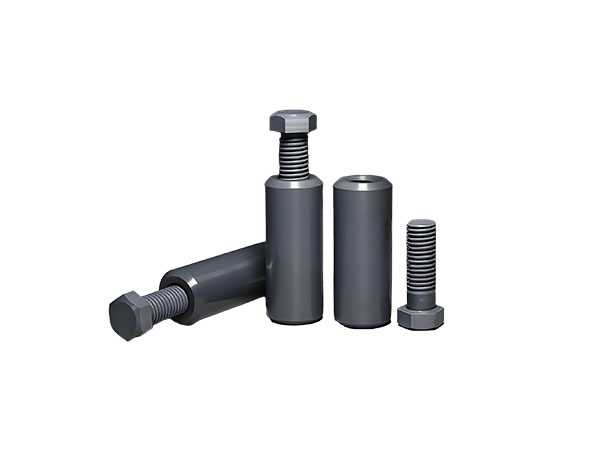
Silicon Nitride Ceramic Screws and Nuts Product Introduction
Silicon nitride ceramic screws and nuts are high-performance engineering ceramic products with the following significant characteristics:
1. High strength: Bending strength can reach over 800 MPa, far exceeding traditional ceramic materials, and can withstand high loads.
2. High hardness: Mohs hardness is second only to superhard materials such as diamond and cubic boron nitride, offering excellent wear resistance.
3. High temperature resistance: Can operate stably at high temperatures up to 1600°C, and mechanical strength is still maintained at 1200°C.
4. Corrosion resistance: Resistant to most inorganic acids (except hydrofluoric acid) and sodium hydroxide solutions below 30%, as well as many organic acids.
5. Low thermal expansion coefficient: Approximately 20% of that of 45# steel, providing good dimensional stability in environments with large temperature variations.
6. Insulation performance: Possesses excellent electrical insulation properties, suitable for electrical equipment applications.
Application Fields
Due to their excellent properties, silicon nitride ceramic screws and nuts are widely used in several high-end fields:
1. Aerospace: Engine components, structural connections, and other components subjected to extreme temperatures and pressures.
2. Automotive Industry: High-temperature and wear-resistant components, improving vehicle performance and safety.
3. Electronics Industry: Connection and fastening of electronic components, ensuring stability and reliability.
4. Chemical Equipment: Corrosion-resistant components for long-term use in acidic and alkaline environments.
5. Nuclear Industry: Support and protective components for nuclear reactors.
Comparative Advantages
Compared with traditional materials, silicon nitride ceramic screws and nuts have the following advantages:
1. Compared with metal materials: lighter weight, smaller thermal expansion coefficient, better thermal shock resistance, and more stable performance in high-temperature environments.
2. Compared with traditional ceramics: higher toughness and better impact resistance; higher strength (flexural strength above 800 MPa); and better wear resistance.
3. Performance in special environments: stable performance in corrosive media; higher reliability in high-speed operation and environments with large temperature fluctuations.
Supports custom specifications.