






Defining Mechanical Strength in Si₃N₄ Ceramics
Silicon nitride (Si₃N₄) is universally recognized as one of the most mechanically robust advanced ceramics available. However, "strength" in ceramics is a multi-dimensional property. It encompasses flexural strength (resistance to bending-induced tensile failure), compressive strength (resistance to crushing), fracture toughness (resistance to crack propagation), and hardness (resistance to localized plastic deformation).
Among these, flexural strength (measured via 3-point or 4-point bending tests per ASTM C1161) is the most critical design metric, as ceramic components rarely fail in pure compression. Si₃N₄ ceramics demonstrate flexural strengths ranging from 300 MPa to over 1,200 MPa-a massive variance dictated entirely by the manufacturing route, raw powder purity, additive system, and resulting microstructure.
Extended Knowledge: The Weibull Modulus (m)
Because ceramics are brittle and fail from critical flaws (pores, inclusions, microcracks), their strength is statistical, not absolute. The Weibull modulus (m) quantifies the scatter in strength data. A low m (e.g., 5-8 for porous RBSN) means high variability and unpredictable failure. A high m (e.g., >15 for premium GPSN/HIP) indicates a narrow strength distribution and high reliability-meaning the material is safe for dynamic, safety-critical applications like aerospace bearings and EV traction motors. Design allowables are calculated at a specified survival probability (typically 99.9%), not at the mean strength.
Flexural Strength Across Si₃N₄ Processing Routes
The manufacturing method fundamentally dictates the density, grain morphology, glassy phase content, and flaw population of the final component. Below is a comparative analysis of the four primary Si₃N₄ processing routes and their mechanical strength envelopes.
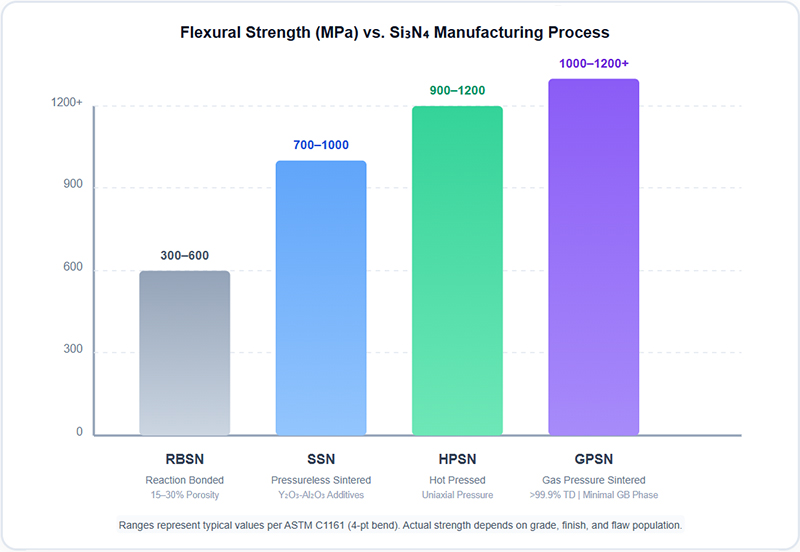
Diagram 1: Flexural Strength Range by Si₃N₄ Manufacturing Process
RBSN (Reaction-Bonded Si₃N₄)
Produced by direct nitridation of Si powder at 1400-1450°C. Residual porosity of 15-30% limits strength to 300-600 MPa. Excellent thermal shock resistance and near-net-shape capability (minimal shrinkage). Used for kiln furniture, burner nozzles, and thermocouple protection tubes where moderate strength suffices.
SSN (Pressureless Sintered Si₃N₄)
Uses Y₂O₃-Al₂O₃ or MgO additives for liquid-phase sintering at 1750-1850°C. Achieves 700-1,000 MPa with good complex geometry capability (injection molding, extrusion). Interlocking β-grains provide reliable toughness. Standard grade for industrial wear parts, valve seats, and pump seals.
HPSN (Hot-Pressed Si₃N₄)
Uniaxial pressure (20-30 MPa) applied during sintering yields near-theoretical density and 900-1,200 MPa. Highly refined, aligned grain structure with excellent edge strength. Limited to simple geometries (pucks, blocks, discs). Ideal for cutting tool inserts, armor components, and precision gauge blocks.
GPSN (Gas Pressure Sintered Si₃N₄)
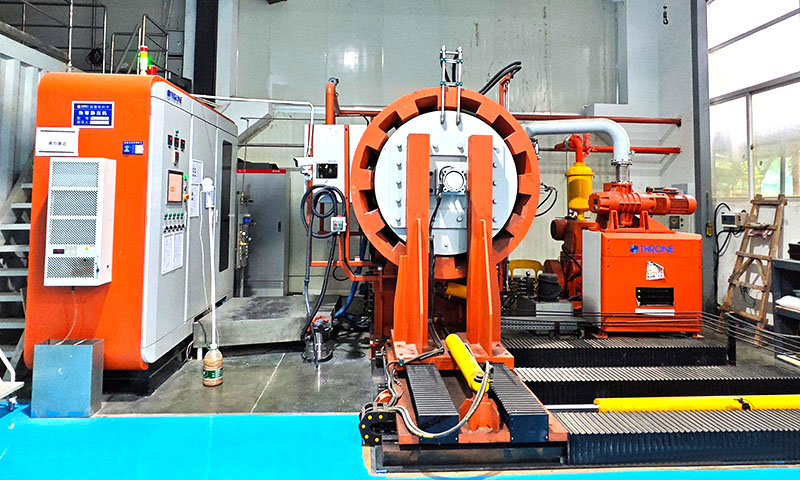
High N₂ overpressure (1-10 MPa) suppresses Si₃N₄ decomposition, enabling full densification (>99.9% TD) with minimal additives at 1800-1950°C. Achieves >1,000-1,200+ MPa and KIC >6 MPa·m½. The undisputed benchmark for hybrid bearings, EV motors, aerospace turbomachinery, and semiconductor equipment.
Microstructural Drivers of Strength & Toughness
The mechanical strength of Si₃N₄ is not merely a function of chemistry-it is an engineered emergent property of its microstructure. Two primary factors dictate whether a Si₃N₄ component will yield at 500 MPa or survive at 1,200 MPa:
Grain Morphology: The β-Si₃N₄ Network
During liquid-phase sintering, equiaxed α-Si₃N₄ grains dissolve into the Y-Si-Al-O-N melt and reprecipitate as elongated β-Si₃N₄ crystals (aspect ratio 5-15:1) via Ostwald ripening. These grains form a self-reinforcing, interlocking 3D network that actively resists crack propagation through two synergistic mechanisms:
Crack Deflection: Cracks are forced to travel around elongated grains along tortuous intergranular paths, increasing total fracture surface area and dissipating energy.
Crack Bridging: Intact elongated grains span the crack wake behind the advancing tip, applying mechanical closure forces that shield the crack tip from the applied stress intensity factor (KI).
Grain Pull-out: Frictional sliding of debonded grains during pull-out dissipates additional fracture energy proportional to aspect ratio and interface shear strength.
This self-toughening gives GPSN Si₃N₄ a rising R-curve: toughness increases with crack extension, unlike monolithic ceramics with flat R-curves.
Porosity & Critical Flaw Size
According to Griffith's theory of brittle fracture, strength is inversely proportional to the square root of the critical flaw size: σf ∝ KIC / √(π·c). In ceramics, the "critical flaw" is almost always a residual pore, an agglomerate, a large inclusion, or a grinding-induced microcrack.
RBSN: 15-30% interconnected porosity creates massive stress concentrators → critical flaw size ~10-50 μm → Low strength (300-600 MPa).
SSN: 1-3% residual porosity → flaw size ~3-10 μm → Moderate strength (700–1000 MPa).
HPSN/GPSN: >99.9% TD → flaw size reduced to sub-micron grain boundary scale (~0.5-2 μm) → Maximum theoretical strength (1000-1200+ MPa).
Even a 1% increase in residual porosity can reduce flexural strength by 15-20%. This exponential sensitivity is why HIP post-treatment is mandatory for bearing-grade Si₃N₄.
Grain Boundary Phase: The Strength-Toughness Trade-off
The amorphous Y-Si-Al-O-N grain boundary film formed during liquid-phase sintering is a double-edged sword. A thicker film promotes better wetting and densification (higher strength) but reduces high-temperature creep resistance and fracture toughness (the glassy phase is weaker than crystalline Si₃N₄). Premium GPSN grades minimize additive content (5-7 wt% vs. 10-12 wt% for standard SSN) and employ post-sintering devitrification annealing to convert the glassy phase into crystalline silicates (Y₂Si₂O₇), optimizing both room-temperature strength and high-temperature performance.
Si₃N₄ vs. Competing Engineering Ceramics
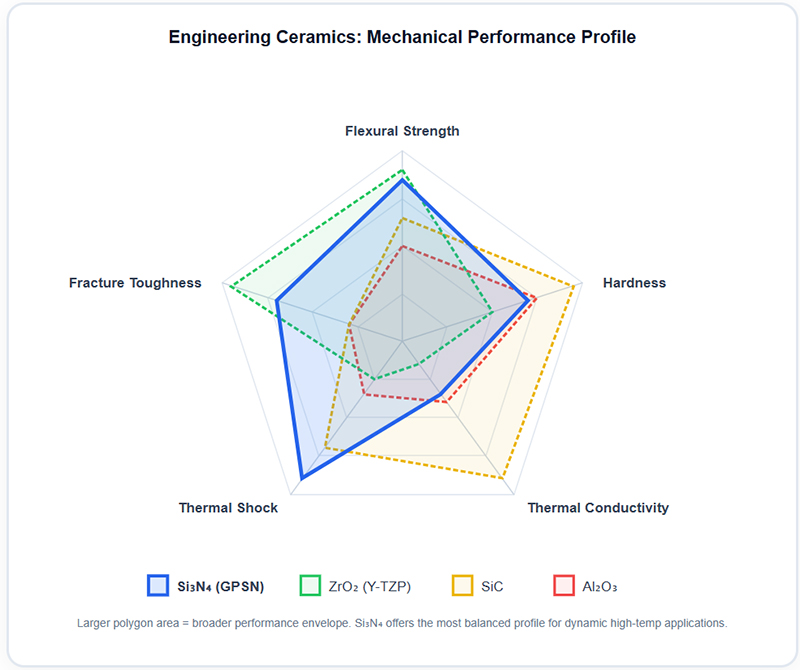
While Alumina (Al₂O₃), Silicon Carbide (SiC), and Zirconia (ZrO₂) are widely used structural ceramics, Si₃N₄ occupies a unique "sweet spot" in the materials selection matrix-particularly where dynamic loading, thermal shock, and elevated temperatures coexist.
Diagram 2: Multi-Axis Mechanical Property Radar Comparison
| Material | Flexural Strength | Fracture Toughness | Hardness (HV) | Max Service Temp | Primary Limitation |
|---|---|---|---|---|---|
| Si₃N₄ (GPSN) | 1,000-1,200+ MPa | 6.0-8.0 MPa·m½ | 1500-1700 | 1200-1400°C | High manufacturing cost; diamond machining required |
| ZrO₂ (Y-TZP) | 900-1,500 MPa | 8.0-12.0 MPa·m½ | 1200-1400 | 600-800°C | Phase instability & catastrophic strength loss >800°C |
| SiC (Sintered) | 400-800 MPa | 3.0-4.5 MPa·m½ | 2500-2800 | 1400-1600°C | Extreme brittleness; poor impact/shock resistance |
| Al₂O₃ (99.8%) | 300-600 MPa | 3.0-4.0 MPa·m½ | 1600-1800 | 1000-1200°C | Lowest strength & toughness among structural ceramics |
High-Temperature Strength Retention
Room-temperature strength is only half the story. In applications like turbocharger rotors, gas turbine components, high-speed spindles, and aerospace turbopumps, components operate continuously at 800°C-1,200°C. Here, Si₃N₄ dramatically outperforms its competitors.
Zirconia (Y-TZP) relies on a metastable tetragonal phase for its exceptional room-temperature toughness. Above 600-800°C, this phase destabilizes, and the material undergoes catastrophic strength degradation-losing 50-70% of its RT strength. Alumina suffers from grain boundary sliding and creep at elevated temperatures due to its lower melting point and glassy impurities at triple junctions.
GPSN Silicon Nitride, however, retains >80% of its room-temperature flexural strength at 1,200°C. This is achieved through grain boundary engineering: post-sintering annealing at 1400–1600°C devitrifies the amorphous Y-Si-Al-O-N grain boundary film into highly refractory crystalline silicates (e.g., Y₂Si₂O₇, melilite). This raises the effective glass transition temperature of the grain boundary from ~900°C to >1300°C, preventing viscous flow and creep under load at extreme temperatures. For applications demanding sustained strength above 1000°C, Si₃N₄ is often the only viable monolithic ceramic option.
Application-Specific Material Selection Matrix
Selecting the correct Si₃N₄ grade requires balancing mechanical strength requirements against manufacturing costs, geometric complexity, and operating environment.
Kiln Furniture & Thermal Fixtures
Recommended: RBSN
Why: Moderate strength (400 MPa) is sufficient for static thermal loads. Near-net-shape capability and excellent thermal shock resistance keep costs low for large, simple geometries. Minimal shrinkage simplifies dimensional control.
Industrial Wear Parts & Valves
Recommended: SSN
Why: Good balance of strength (800 MPa) and toughness. Can be formed into complex shapes (valve seats, pump seals, nozzles) via injection molding or extrusion before sintering. Cost-effective for non-safety-critical applications.
Metal Cutting Tool Inserts
Recommended: HPSN
Why: Maximum density and refined, aligned grain structure provide the edge strength and wear resistance needed for high-speed machining of cast iron and nickel superalloys. Simple insert geometries suit uniaxial pressing.
EV Bearings & Aerospace Rotors
Recommended: GPSN (+HIP)
Why: Extreme dynamic loads require >1,000 MPa strength, high Weibull modulus (>15), and maximum rolling contact fatigue life. Only GPSN+HIP provides the defect-free microstructure and statistical reliability demanded by safety-critical applications.
Semiconductor Equipment
Recommended: GPSN (High-Purity Grade)
Why: Ultra-high purity (>99.99%), plasma erosion resistance, and low particle generation. Survives aggressive CF₄/O₂ plasmas and 1200°C furnace cycles without metallic contamination. 5-10× longer service life vs. quartz or Al₂O₃.
High-Temp Structural (>1000°C)
Recommended: GPSN (Devitrified GB)
Why: Only monolithic ceramic retaining >80% RT strength at 1200°C. ZrO₂ fails above 800°C; Al₂O₃ creeps above 1000°C. Essential for gas turbine hot-div components and hypersonic leading edges.
Engineering Frequently Asked Questions
Q1: Why does Gas Pressure Sintered (GPSN) silicon nitride have the highest mechanical strength?
GPSN achieves the highest mechanical strength (>1,000 MPa) because high nitrogen overpressure (up to 10 MPa) suppresses Si₃N₄ thermal decomposition at sintering temperatures above 1800°C. This enables full densification (>99.9% TD) with minimal sintering additives, resulting in a reduced glassy grain boundary phase and an optimized interlocking network of elongated β-Si₃N₄ grains. The combination of near-zero porosity (eliminating critical flaw sites) and crack-bridging microstructure maximizes both flexural strength and fracture toughness simultaneously.
Q2: How does Si₃N₄ fracture toughness compare to alumina, silicon carbide, and zirconia?
At room temperature: Y-TZP Zirconia has the highest toughness (8-12 MPa·m½) via transformation toughening, but degrades severely above 800°C. GPSN Si₃N₄ offers 6-8 MPa·m½ through crack bridging and deflection by elongated β-grains, retaining this toughness to >1200°C. Sintered SiC has only 3-4.5 MPa·m½ (equiaxed grains, no toughening mechanism). Alumina (99.8%) has 3-4 MPa·m½. Si₃N₄ provides the best balance of high toughness AND high-temperature stability for dynamic structural applications.
Q3: What is the significance of the Weibull modulus in Si₃N₄ strength evaluation?
Ceramics fail from critical flaws (pores, inclusions, microcracks), making strength a statistical property rather than a deterministic value. The Weibull modulus (m) quantifies the scatter in strength data: a low m (5-8 for porous RBSN) indicates wide variability and unpredictable failure; a high m (>15 for premium GPSN/HIP) indicates narrow strength distribution and high reliability. For safety-critical applications like aerospace bearings and EV motor components, a high Weibull modulus is as important as the mean strength value itself, as it determines the design allowable stress at a given survival probability (typically 99.9%).
Q4: At what temperature does Si₃N₄ begin to lose mechanical strength?
Premium GPSN Si₃N₄ retains >80% of its room-temperature flexural strength up to approximately 1200°C. Above this temperature, strength gradually declines as the residual amorphous grain boundary phase softens. Post-sintering annealing (devitrification heat treatment at 1400-1600°C) converts this glassy phase into crystalline silicates (e.g., Y₂Si₂O₇), extending useful strength retention to ~1400°C. By contrast, Y-TZP Zirconia begins significant strength degradation above 600-800°C due to tetragonal-to-monoclinic phase instability, and alumina suffers grain boundary sliding above ~1000°C.