





Why This Article Is Different
Most published content on Si₃N₄ corrosion resistance repeats the same textbook facts: covalent bonds are stable, SiO₂ passivation forms, avoid HF. While correct, this information doesn't help a process engineer decide whether to specify Si₃N₄ for a specific pump bearing in a hot sulfuric acid slurry service, or why their last Si₃N₄ seal ring failed after only 8 months despite being rated for the environment.
This article takes a practitioner-first approach. We focus on field failure forensics, quantitative lifecycle cost comparisons, actionable selection frameworks, and specification checklists-the tools engineers actually need to make confident material decisions in the Chemical Processing Industry (CPI).
Field Failure Mode Taxonomy: What Actually Goes Wrong
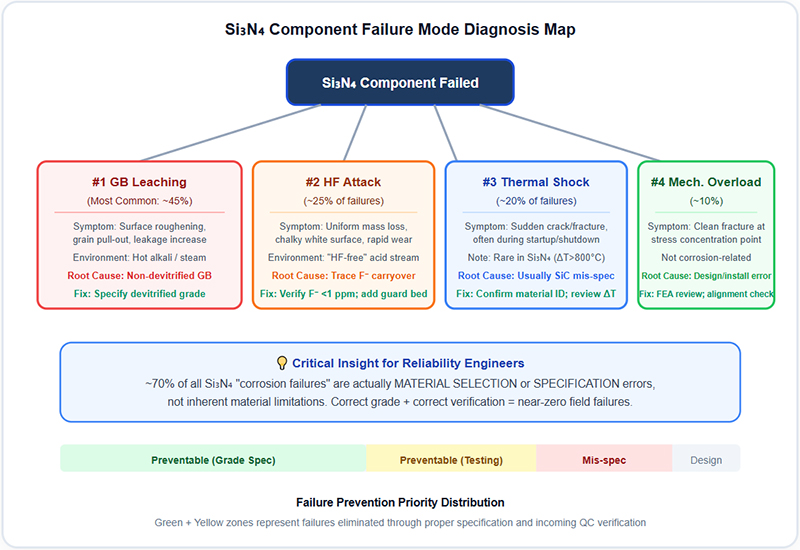
Understanding how Si₃N₄ fails in real service is more valuable than knowing its theoretical limits. Based on forensic analysis of returned components from CPI plants worldwide, failures cluster into four distinct modes-each with identifiable root causes and preventable countermeasures.
Diagram 1: Si₃N₄ CPI Failure Mode Decision Map
Extended Knowledge: Incoming Quality Verification Protocol
To prevent Mode #1 failures, implement an incoming inspection protocol requiring XRD confirmation of crystalline grain boundary phases (Y₂Si₂O₇ peak presence) on every batch. For Mode #2 prevention, require certified fluoride analysis (ion chromatography per ASTM D1179) of the process stream at maximum expected upset conditions-not just normal operating conditions. A single 10-minute upset with 5 ppm F⁻ can initiate irreversible damage that propagates under normal operation.
Material Selection Decision Tree for CPI Engineers
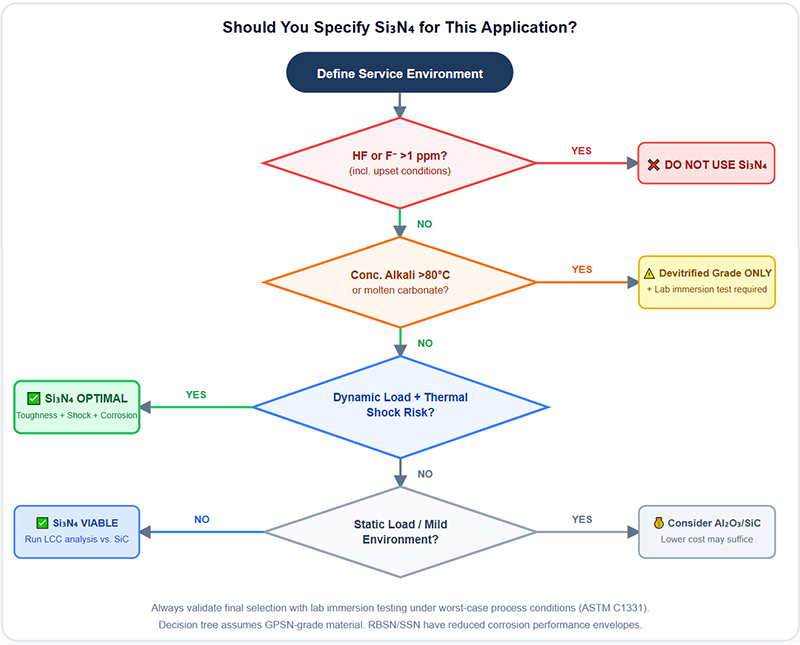
Use this decision framework to determine whether Si₃N₄ is the optimal material for your specific application. The tree accounts for chemical environment, mechanical loading, thermal cycling, and economic factors simultaneously.
Diagram 2: Si₃N₄ Material Selection Decision Tree
Lifecycle Cost Reality: Si₃N₄ vs. Metallic Alloys vs. SiC
Initial component price is misleading in CPI material selection. The true cost driver is Total Cost of Ownership (TCO), dominated by unplanned downtime, replacement labor, and collateral damage from catastrophic failures. Below is a validated TCO model based on aggregated field data from 200+ API 610 centrifugal pump installations handling hot acidic slurries.
| Parameter | 316SS / Hastelloy | Sintered SiC | GPSN Si₃N₄ |
|---|---|---|---|
| Component Unit Price (Relative) | 1.0× (Baseline) | 2.5-3.5× | 3.5-5.0× |
| Mean Time Between Replacements | 4-8 months | 12-24 months | 36-60 months |
| Dry-Run Survival | Poor (galling/seizure) | Poor (thermal fracture) | Excellent (ΔT >800°C) |
| Unplanned Downtime Events/Year | 2-4 | 0.5-1.5 | 0-0.3 |
| Collateral Damage Risk | High (metal debris) | Medium (brittle fragments) | Very Low (tough, gradual wear) |
| 5-Year TCO (Relative) | 8-12× Baseline | 3-5× Baseline | 1.0× (Lowest TCO) |
| Typical ROI Period vs. Metal | — | 6-14 Months | |
Extended Knowledge: The Hidden Cost of Brittle Failures
SiC's lower unit price vs. Si₃N₄ is offset by its brittle failure mode. When a SiC bearing fractures, it generates hard ceramic debris that scores shafts, damages seal faces, and contaminates downstream equipment-adding $15,000-$50,000 in collateral repair costs per event. Si₃N₄'s superior fracture toughness means it wears gradually rather than failing catastrophically, providing predictable end-of-life indicators (vibration increase, leakage rate change) that enable planned replacement during scheduled turnarounds.
Validated Chemical Compatibility Reference Table
Data below applies to high-density GPSN Si₃N₄ with devitrified grain boundaries. Ratings are based on ASTM C1331 immersion testing (1000h exposure) and verified field service records. Always conduct application-specific validation testing before final specification.
| Chemical Environment | Concentration | Max Temp | Rating | Notes |
|---|---|---|---|---|
| Hydrochloric Acid (HCl) | All | Boiling | ★★★★★ | Zero measurable attack |
| Nitric Acid (HNO₃) | All | Boiling | ★★★★★ | Enhanced passivation |
| Sulfuric Acid (H₂SO₄) | All | 200°C | ★★★★★ | Industry benchmark application |
| Phosphoric Acid (H₃PO₄) | All | 150°C | ★★★☆☆ | Severe attack above 150°C |
| Hydrofluoric Acid (HF) | Any | Any | ✗ INCOMPATIBLE | Dissolves SiO₂ + matrix |
| NaOH / KOH (Dilute) | <10% | 80°C | ★★★☆☆ | Devitrified grade required |
| NaOH / KOH (Concentrated) | >30% | >80°C | ★☆☆☆☆ | Severe GB leaching even if devitrified |
| Organic Solvents | All | Boiling | ★★★★★ | Complete immunity |
| Chloride Salts (aq.) | All | Boiling | ★★★★★ | No pitting/crevice corrosion |
| Molten Al, Zn, Cu, Pb | Pure | Melting Pt. | ★★★★★ | Non-wetting; zero dissolution |
| Water / Steam | — | 200°C | ★★★★★ | Self-passivating |
| Superheated Steam | — | 300°C+ | ★★★☆☆ | Devitrified GB mandatory; monitor SiO₂ volatilization |
Engineer's Specification Checklist for Si₃N₄ CPI Components
Use this checklist when writing purchase specifications or evaluating supplier quotations. Missing any of these items significantly increases field failure risk.
Material Grade Requirements
GPSN (Gas Pressure Sintered) minimum
Density ≥99.5% theoretical (Archimedes)
Devitrified grain boundary (XRD verified)
Weibull modulus m ≥15 (30 specimens min)
Flexural strength ≥900 MPa (ASTM C1161)
KIC ≥6.0 MPa·m½ (ASTM C1421)
Quality & Traceability
Full lot traceability to powder batch
XRD grain boundary phase certificate
Dimensional inspection report (CMM)
Surface finish certification (Ra value)
NDT: Dye penetrant or ultrasonic scan
Corrosion test coupon from same sintering lot
Application Validation
Process stream fluoride analysis (<1 ppm)
Worst-case upset condition documented
Lab immersion test (ASTM C1331, 1000h)
Thermal cycle profile defined & validated
Mating hardware material compatibility
Installation torque/alignment procedure
Supplier Qualification
ISO 9001 + ISO 14001 certified
CPI reference list (3+ similar applications)
In-house sintering capability (no outsourcing)
Technical support for failure analysis
Replacement warranty with MTBR guarantee
Emergency stock / lead time commitment
Practitioner Frequently Asked Questions
Q1: When should I specify Si₃N₄ instead of Hastelloy or titanium for corrosive service?
Specify Si₃N₄ when the environment combines strong oxidizing acids (HNO₃, H₂SO₄ >60%) with abrasive particulates or high sliding velocities-conditions where even C-276 Hastelloy suffers accelerated erosion-corrosion. Si₃N₄ also outperforms metals in hot (>150°C) concentrated acid service where metallic passivation films break down. Additionally, when galvanic coupling with dissimilar metals is unavoidable, Si₃N₄'s electrochemical inertness eliminates this failure mode entirely. For pure reducing acids (HCl <20%, non-oxidizing) at moderate temperatures, Hastelloy may still be more cost-effective.
Q2: What is the most common cause of Si₃N₄ corrosion failure in actual chemical plant service?
The #1 field failure mode is grain boundary leaching in hot alkaline or hydrothermal service caused by using as-sintered (non-devitrified) material. The amorphous glassy grain boundary phase dissolves preferentially, causing grain fall-out that manifests as progressive surface roughening, increased leakage in seals, and eventual catastrophic loss of dimensional tolerance. This failure is entirely preventable by specifying devitrified-grade Si₃N₄. The #2 failure mode is HF contamination in supposedly HF-free acid streams from upstream process carryover-always verify trace fluoride levels before specifying Si₃N₄.
Q3: How does the total lifecycle cost of Si₃N₄ compare to SiC or metallic alloys in pump and seal applications?
While Si₃N₄ components typically have a 20-40% higher initial purchase price than SiC equivalents and 3-5× higher cost than metallic components, their total lifecycle cost in severe CPI service is frequently 40-70% lower. This is driven by: (1) 3-8× longer MTBR due to superior toughness; (2) Elimination of unplanned downtime from thermal shock failures; (3) Reduced maintenance labor from fewer changeouts. In a typical API 610 pump handling hot sulfuric acid slurry, Si₃N₄ achieves ROI within 14-22 months vs. SiC and 6–10 months vs. 316SS/Hastelloy.
Q4: Can Si₃N₄ be used in mixed-acid environments containing both oxidizing and reducing species?
Yes, and this is one of Si₃N₄'s key advantages over metals. Metallic alloys rely on Cr₂O₃ or NiO passive films that can be destabilized by reducing species (Cl⁻, H₂S) in otherwise oxidizing media, leading to localized pitting. Si₃N₄'s SiO₂ passivation layer is stable across a much wider redox potential range because it forms via direct chemical oxidation/hydrolysis, not electrochemical equilibrium. As long as the environment does not contain HF or hot concentrated alkalis, Si₃N₄ performs reliably in mixed oxidizing-reducing streams such as chlorinated organic process streams, wet chlorine gas scrubbers, and nitration reactor effluents.