




The Kinematic Paradigm Shift in Rolling Element Bearings
The transition from monolithic AISI 52100 or M50 tool steel bearings to hybrid ceramic bearings (Si₃N₄ balls with steel races) is not merely a material substitution; it is a fundamental redesign of the bearing's internal kinematics and tribological regime. As modern turbomachinery, EV traction motors, and precision spindles push DN values (bore diameter × RPM) beyond 1,000,000, the physical limitations of steel-specifically its high density and electrical conductivity-become the primary bottlenecks for reliability and efficiency.
Silicon Nitride (Si₃N₄) introduces a unique combination of low specific gravity, high elastic modulus, and wide-bandgap dielectric properties. By altering the Hertzian contact mechanics, optimizing the Elastohydrodynamic Lubrication (EHL) film thickness, and eliminating parasitic gyroscopic moments, Si₃N₄ rolling elements enable bearing architectures to operate at the extreme edges of the Stribeck curve without succumbing to surface-initiated fatigue or electrical erosion.
Advanced Material Parameters: Si₃N₄ vs. Bearing Steel
The performance enhancements of hybrid bearings are directly derived from the delta in fundamental material properties between hot-isostatically pressed (HIP) Si₃N₄ and conventional bearing steels.
| Parameter | HIP Si₃N₄ (Ceramic) | AISI 52100 / M50 (Steel) | Tribological / Dynamic Impact |
|---|---|---|---|
| Density (ρ) | 3.20 g/cm³ | 7.85 g/cm³ | Reduces centrifugal force and gyroscopic moment by ~60%. |
| Elastic Modulus (E) | 310 GPa | 210 GPa | Higher stiffness reduces Hertzian contact area, minimizing spin-slip friction. |
| Poisson's Ratio (ν) | 0.26 | 0.30 | Alters the semi-axes of the contact ellipse, optimizing EHL pressure distribution. |
| Volume Resistivity | > 10¹⁴ Ω·cm | ~ 10⁻⁵ Ω·cm | Acts as a dielectric barrier, preventing capacitive EDM arcing through the oil film. |
| Coefficient of Thermal Expansion (CTE) | 3.2 × 10⁻⁶ /K | 12.5 × 10⁻⁶ /K | Maintains precise internal clearance and preload stability under thermal gradients. |
| Fracture Toughness | 6.0 - 8.0 MPa·m½ | ~ 15-20 MPa·m½ | Lower than steel, necessitating HIP sintering and strict NDT to prevent brittle spalling. |
Hertzian Contact Mechanics and EHL Film Optimization
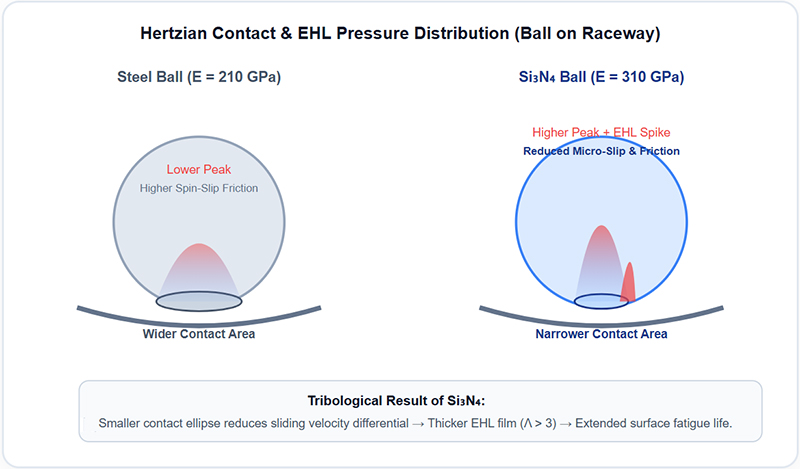
The interaction between the rolling element and the raceway is governed by Hertzian contact theory. Because Si₃N₄ possesses a 50% higher elastic modulus than steel, the resulting contact ellipse is smaller. This geometric alteration profoundly impacts the Elastohydrodynamic Lubrication (EHL) regime and the internal sliding friction (spin-slip) of the bearing.
SVG Diagram 1: Hertzian Contact Ellipse & EHL Pressure Profile
The Spin-Slip Phenomenon
In angular contact bearings, balls undergo a spinning motion relative to the raceway. A wider contact ellipse (steel) creates a larger velocity differential across the contact zone, generating severe micro-slip and heat. The narrower contact ellipse of Si₃N₄ drastically reduces this spin-slip friction, which is the dominant heat source in high-speed spindles.
Specific Film Thickness (Λ Ratio)
The Λ ratio (lubricant film thickness divided by composite surface roughness) dictates fatigue life. Because Si₃N₄ generates less frictional heat, the lubricant's viscosity remains higher in the contact zone. Combined with smoother ceramic surfaces, this pushes the Λ ratio well above 3.0 (full EHL regime), effectively separating the asperities and preventing surface-initiated micropitting.
5 Core Dynamic & Tribological Enhancements
1. Gyroscopic Moment & Centrifugal Load Reduction
Centrifugal force propto pushes balls against the outer race, increasing contact stress. Gyroscopic moment causes the balls to skid, generating immense heat. With 41% of steel's density, Si₃N₄ balls reduce both parasitic loads by ~60%, allowing the bearing to operate at ultra-high DN values with minimal skidding and thermal runaway.
2. Dielectric Isolation & EDM Mitigation
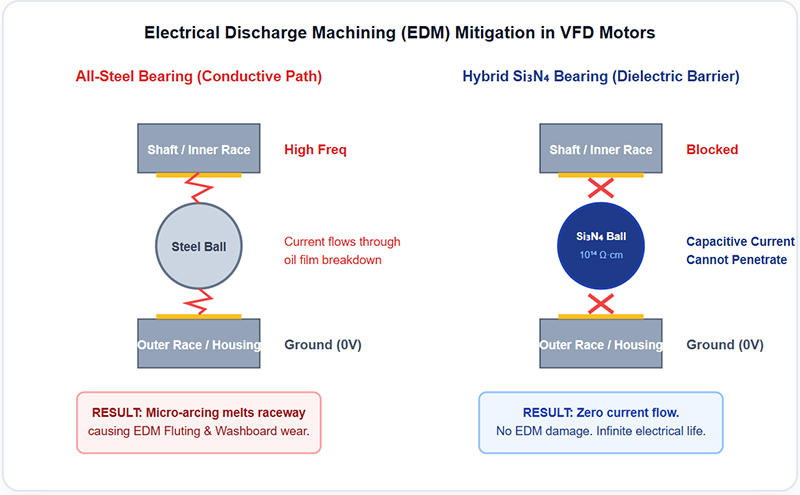
In VFD-driven motors, common-mode voltages induce shaft currents that arc through the lubricant film, causing Electrical Discharge Machining (EDM) fluting. Si₃N₄'s dielectric strength (>10 kV/mm) and high volume resistivity completely block these capacitive discharge currents, eliminating the primary failure mode in modern EV and industrial traction motors.
3. Thermal Preload Stability
Steel expands significantly when heated (CTE 12.5 ppm/K), which increases internal preload in high-speed spindle bearings, leading to seizure. Si₃N₄'s low CTE (3.2 ppm/K) means the balls barely expand thermally. This maintains the engineered contact angle and preload stability across wide thermal gradients, ensuring consistent rigidity and rotational accuracy.
4. Debris Denting & Wear Resistance
In contaminated lubrication regimes, hard particles indent steel raceways, creating stress risers that initiate spalling. Si₃N₄ balls (HV ~1700) are twice as hard as steel and highly chemically inert. They resist indentation and tend to crush or push debris aside without creating severe raised edges (shoulders) on the raceway, improving the ISO 281 contamination factor.
5. Boundary Lubrication Survival
During startup, starvation, or marginal EHL conditions, asperity contact occurs. The tribological pairing of Si₃N₄ against steel exhibits a significantly lower coefficient of friction and higher resistance to adhesive wear (scuffing/galling) compared to steel-on-steel. This provides a critical safety margin against catastrophic seizure during transient lubrication failures.
The Physics of Electrical Erosion and Si₃N₄ Dielectric Shielding
Electrical erosion is the leading cause of premature failure in inverter-driven motors. The diagram below contrasts the electrical discharge path in an all-steel bearing versus the dielectric blocking mechanism of a Si₃N₄ hybrid bearing.
SVG Diagram 2: EDM Fluting Mechanism vs. Si₃N₄ Dielectric Blocking
High-Fidelity Applications in Advanced Engineering
EV Traction Motors (800V Architectures)
As EV platforms transition to 800V SiC inverters, common-mode voltages and switching frequencies increase drastically, exacerbating bearing currents. Si₃N₄ hybrid bearings are now mandatory OEM specifications to prevent EDM fluting at motor speeds exceeding 20,000 RPM, ensuring the drivetrain survives the vehicle's 15-year lifecycle.
Ultra-High-Speed Machine Tool Spindles
Aerospace milling requires spindles operating at 2,000,000+ DN values. The reduction in gyroscopic moment and spin-slip friction provided by Si₃N₄ balls prevents thermal seizure and maintains sub-micron radial runout, enabling the precise surface finishes required for titanium and Inconel components.
Aerospace Gas Turbines & Generators
In aircraft engines and auxiliary power units (APUs), bearings operate at extreme temperatures where steel loses hardness and lubricants thin out. Si₃N₄'s retention of elastic modulus at 800°C+, combined with its boundary lubrication survival traits, provides critical reliability margins for aviation safety.
Wind Turbine Main Shaft & Generators
Large-scale direct-drive wind generators suffer from stray grounding currents. Si₃N₄ insulated bearings prevent electrical erosion in main shaft and generator bearings, extending service intervals from 2 years to 7+ years, drastically reducing the Levelized Cost of Energy (LCOE) for offshore wind farms.
System-Level Tribological Comparison
| Engineering Metric | All-Steel Bearing | Hybrid Si₃N₄ Bearing |
|---|---|---|
| Centrifugal Load at High DN | High (Limits max RPM) | Reduced by ~60% |
| Spin-Slip Friction Coefficient | Higher (Generates heat) | Lower (Narrower contact ellipse) |
| Dielectric Breakdown Resistance | None (Conductor) | > 10 kV/mm (Insulator) |
| Thermal Preload Shift | Significant (Risk of seizure) | Minimal (Stable clearance) |
| ISO 281 Life Factor (Contaminated) | Baseline | Significantly Improved |
Precision Manufacturing & Non-Destructive Testing (NDT)
The fatigue life of ceramic rolling elements is strictly governed by the Weibull distribution of subsurface defects. Standard sintering leaves micro-porosity that acts as stress concentrators under high Hertzian pressures. HUACIJULI employs advanced manufacturing protocols to guarantee structural integrity:
Hot Isostatic Pressing (HIP)
Post-sintering HIP treatment applies isostatic argon pressure at >1600°C, collapsing residual micro-pores and achieving >99.99% theoretical density. This eliminates the primary initiation sites for subsurface shear fatigue.
Ultrasonic & Eddy Current NDT
Every production batch undergoes high-frequency ultrasonic immersion testing and eddy current scanning to detect sub-micron inclusions or agglomerates, ensuring a defect-free microstructure for aerospace and spindle grades.
Sub-Nanometer Finishing
Advanced magnetic abrasive finishing achieves ISO Grade 3 (G3) sphericity (≤0.08μm) and surface roughness < 0.005\mu. This ultra-smooth topography is critical for maximizing the EHL ratio at extreme speeds.
Engineering the Next Generation of Drivetrains?
Partner with HUACIJULI for HIP-densified, NDT-certified Si₃N₄ bearing balls. From prototype tribological testing to high-volume automotive supply.
Request Technical Datasheet & SamplesEngineering Frequently Asked Questions (FAQ)
Q1: How does Si₃N₄ affect the ISO 281 fatigue life calculation?
The modern ISO 281 standard uses the life modification factor, which accounts for lubrication conditions, contamination, and fatigue load limits. Because Si₃N₄ balls run cooler (preserving lubricant viscosity), resist debris denting (lowering the contamination factor), and have a different fatigue load limit than steel, the calculated factor for hybrid bearings is often significantly higher, resulting in extended adjusted rating life.
Q2: Can Si₃N₄ balls cause increased wear on the steel raceways due to higher hardness?
No. Counterintuitively, the harder Si₃N₄ balls actually reduce raceway wear. Because the ceramic balls generate less centrifugal force and spin-slip friction, the overall thermal and mechanical stress on the raceway is lowered. Furthermore, the smoother ceramic surface acts to "polish" the raceway during the run-in phase, improving the EHL film formation and reducing adhesive wear.
Q3: What is the difference between capacitive discharge (EDM) and circulating currents in motors?
Capacitive discharge (EDM) occurs when high from the VFD couples capacitively to the shaft, charging it until the lubricant film breaks down, causing micro-arcing. Circulating currents are caused by asymmetric magnetic flux inducing an electromotive force (EMF) around the shaft-bearing-housing loop. Si₃N₄ hybrid bearings perfectly block EDM currents. For large motors with high circulating currents, an Si₃N₄ bearing on the non-drive end (NDE) is used to break the electrical loop.
Q4: Why is Hot Isostatic Pressing (HIP) mandatory for aerospace-grade Si₃N₄ balls?
In rolling contact fatigue, the maximum orthogonal shear stress occurs slightly below the surface. If a micro-pore or inclusion exists at this depth, it acts as a stress concentrator, initiating a subsurface crack that propagates to the surface, causing catastrophic spalling. HIP sintering applies uniform hydrostatic pressure, eliminating internal voids and ensuring the microstructure is fully dense, thereby pushing the Weibull fatigue life distribution to the extreme right.