





Introduction
In the field of advanced ceramics, silicon nitride (Si₃N₄) and alumina (Al₂O₃) stand out as two of the most widely used engineering materials. Both deliver exceptional performance characteristics that make them indispensable across a wide spectrum of industrial applications - from aerospace propulsion systems to precision medical devices.
However, each material offers a unique set of advantages tailored to specific application requirements. Understanding the nuanced differences between these two ceramic families is critical for engineers, material scientists, and procurement specialists who need to make informed decisions about material selection.
This comprehensive technical guide provides an in-depth comparison of silicon nitride and alumina ceramics, covering their molecular composition, mechanical properties, thermal behavior, electrical characteristics, corrosion resistance, and real-world industrial applications. By the end of this article, you will have a clear understanding of which ceramic material best aligns with your project requirements.
What Are Silicon Nitride and Alumina?
Before diving into a detailed property-by-property comparison, it is essential to understand the fundamental nature and composition of these two ceramic materials.
Silicon Nitride (Si₃N₄)
Silicon nitride is a high-performance engineering ceramic composed of silicon (Si) and nitrogen (N) atoms arranged in a covalently bonded network. It is synthesized through processes such as reaction bonding, hot pressing, or sintering of silicon powder in a nitrogen atmosphere.
Si₃N₄ is renowned for its exceptional strength, fracture toughness, and thermal shock resistance. It is commonly employed in applications demanding high-temperature stability and resistance to mechanical stress, such as turbine components, rolling element bearings, and high-performance seals.
Crystal structures: α-Si₃N₄ (hexagonal), β-Si₃N₄ (hexagonal), and γ-Si₃N₄ (cubic, high-pressure phase).
Alumina (Al₂O₃)
Alumina, also known as aluminum oxide, is one of the most commonly used technical ceramics worldwide. It is composed of aluminum (Al) and oxygen (O) atoms and is available in various purity grades, ranging from 85% to 99.8% Al₂O₃.
Al₂O₃ is prized for its outstanding hardness, electrical insulation properties, and high-temperature capability. It is extensively used in electronics substrates, wear-resistant components, electrical insulators, and structural applications.
Most stable form: α-Al₂O₃ (corundum structure, trigonal crystal system). Other phases include γ, δ, and θ-alumina.
Molecular Composition & Crystal Structure
The distinct properties of silicon nitride and alumina originate from their unique atomic arrangements and bonding characteristics. Below are the molecular composition diagrams illustrating the fundamental building blocks of each ceramic material.
Silicon Nitride (Si₃N₄) - Tetrahedral Network
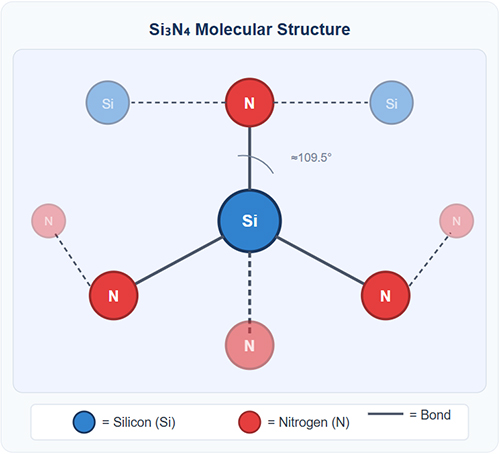
Structure: Each silicon atom is covalently bonded to four nitrogen atoms in a tetrahedral arrangement (sp³ hybridization). Each nitrogen atom is shared among three silicon atoms, forming a dense three-dimensional network. This strong covalent bonding gives Si₃N₄ its remarkable mechanical strength and thermal stability. The β-Si₃N₄ phase (most common in engineering ceramics) consists of interlocking elongated grains that contribute to its high fracture toughness through crack-bridging mechanisms.
Alumina (Al₂O₃) - Corundum Structure
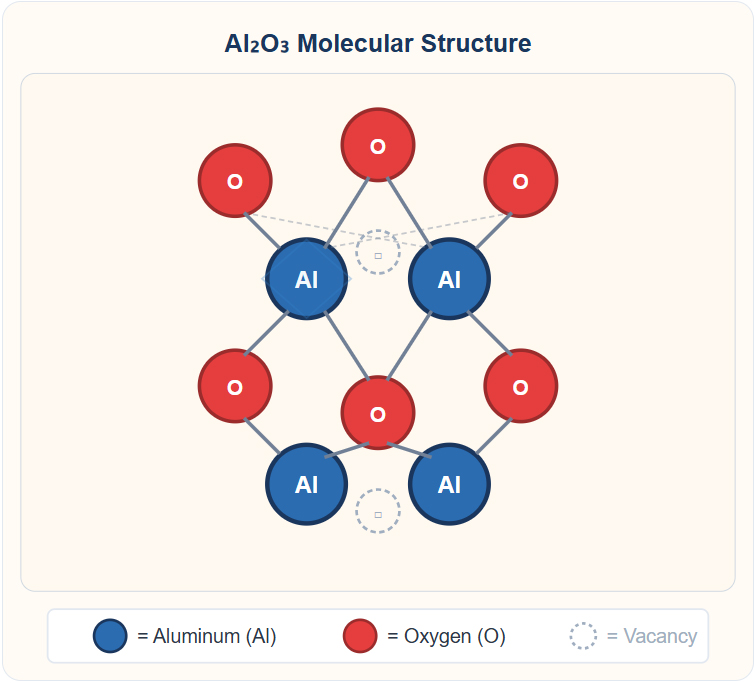
Structure: Alumina adopts the corundum crystal structure (α-Al₂O₃), where oxygen anions form a hexagonal close-packed (HCP) lattice and aluminum cations occupy two-thirds of the available octahedral interstitial sites (the remaining one-third are vacant, shown as □). This ionic bonding with partial covalent character gives Al₂O₃ its extreme hardness (9 on the Mohs scale), excellent electrical insulation, and chemical stability. The ordered arrangement of Al³⁺ ions and vacancies creates a highly symmetric and thermodynamically stable structure.
Key Property Comparison at a Glance
| Property | Silicon Nitride (Si₃N₄) | Alumina (Al₂O₃) |
|---|---|---|
| Chemical Formula | Si₃N₄ | Al₂O₃ |
| Density | 3.17-3.44 g/cm³ | 3.85-3.98 g/cm³ |
| Flexural Strength | 700-1000 MPa ★ | 300-630 MPa |
| Fracture Toughness | 6-8 MPa·m½ ★ | 3-5 MPa·m½ |
| Vickers Hardness | 13-17 GPa | 15-20 GPa ★ |
| Max Operating Temperature | ~1400°C (2550°F)★ | ~1200°C (2192°F) |
| Thermal Shock Resistance | Excellent ★ | Good |
| Electrical Insulation | Good (moderate) | Excellent★ |
| Corrosion Resistance | Excellent | Good (pH-dependent) |
| Coefficient of Friction | Low★ | Moderate |
★=Superior performance in this category. Values are typical ranges for sintered engineering-grade ceramics.
1. Mechanical Strength & Fracture Toughness
Silicon Nitride
One of the most remarkable attributes of silicon nitride is its exceptional mechanical strength and fracture toughness. Among all monolithic ceramics, Si₃N₄ exhibits some of the highest values of flexural strength and resistance to crack propagation.
Under high-stress conditions, silicon nitride is significantly more resistant to cracking and catastrophic failure compared to most other ceramics. Its ability to absorb impact energy and resist deformation under pressure makes it the material of choice for high-performance components such as turbine blades, precision bearings, and mechanical seals.
The elongated β-Si₃N₄ grains create a self-reinforcing microstructure through crack bridging and grain pull-out mechanisms, providing a natural toughening effect that is unique among engineering ceramics.
Alumina
Alumina is well-regarded for its high compressive strength and extreme hardness. With a Vickers hardness of up to 20 GPa (depending on purity and grain size), it is one of the hardest oxide ceramics available.
However, Al₂O₃ is comparatively more brittle than silicon nitride. Its fracture toughness is lower, meaning it is more susceptible to cracking or chipping under impact loading or high-stress conditions.
Despite this limitation, alumina remains an excellent choice for applications where extreme mechanical forces are not the primary concern - such as wear plates, insulating bodies, and structural components under compressive loads.
Extended Insight: The Weibull modulus of Si₃N₄ is typically higher than that of Al₂O₃, meaning silicon nitride exhibits more consistent and predictable mechanical performance - a critical factor in safety-critical aerospace and automotive applications where reliability is paramount.
2. Thermal Resistance & Thermal Shock Performance
Silicon Nitride
Silicon nitride excels in high-temperature environments, capable of sustained operation at temperatures up to 1400°C (2550°F). Its exceptionally low coefficient of thermal expansion (CTE ≈ 3.2 × 10⁻⁶/°C) combined with moderate thermal conductivity provides outstanding thermal shock resistance.
This means Si₃N₄ components can endure rapid temperature fluctuations without cracking or performance degradation - a property that is absolutely critical for aerospace turbine engines, gas turbine components, and high-temperature furnace fixtures.
Alumina
Alumina is also a heat-resistant ceramic, but its optimal performance range typically does not exceed 1200°C (2192°F). While it offers respectable thermal shock resistance, its higher CTE (≈ 8.1 × 10⁻⁶/°C) and higher thermal conductivity make it less stable than silicon nitride under extreme thermal cycling conditions.
Alumina is well-suited for applications involving steady high temperatures - such as kiln furniture, furnace tubes, and refractory linings - but may not be the best choice for components subjected to frequent and rapid temperature changes.
Extended Insight: Thermal shock resistance is often quantified by the parameter R = σ(1-ν)/(Eα), where σ is strength, ν is Poisson's ratio, E is Young's modulus, and α is CTE. Due to its lower E and α values combined with high σ, Si₃N₄ achieves R values 3-5× higher than most alumina grades, making it the preferred choice for thermal cycling applications.
3. Wear & Scratch Resistance
Silicon Nitride
Silicon nitride offers superior wear resistance driven by the combination of its hardness and toughness. Its low coefficient of friction (particularly in self-mated sliding pairs) significantly reduces wear in rotating or sliding components.
This makes Si₃N₄ an exceptionally reliable choice for precision bearings, cutting tools, and wear plates. In fact, silicon nitride bearing balls are now standard in high-speed spindle bearings and hybrid bearings used in motorsport and aerospace applications, extending service life by factors of 3–10× compared to steel.
Alumina
Alumina is renowned for its extreme hardness, which provides excellent resistance to abrasive wear and scratching. It is one of the hardest ceramic materials available, making it ideal for grinding media, wear-resistant linings, and abrasive cutting tools.
However, while alumina is highly wear-resistant, its lower toughness means it may be more susceptible to surface chipping or micro-fracturing under impact or cyclic loading conditions where silicon nitride would perform better.
4. Electrical Insulation Properties
Silicon Nitride
Silicon nitride is a good electrical insulator, but its dielectric properties are not as outstanding as those of alumina. In certain applications - such as power electronics and semiconductor processing equipment - Si₃N₄ can adequately meet moderate insulation requirements. Its dielectric constant (εᵣ ≈ 8-9) and dielectric strength make it suitable for specific electronic packaging and substrate applications, particularly where mechanical toughness is also required.
Alumina
Alumina is the gold standard for electrical insulation among engineering ceramics. Its high resistivity (10¹⁴ Ω·cm at room temperature), excellent dielectric strength, and low dielectric loss make it the material of choice for electronic substrates, high-voltage insulators, spark plug bodies, and capacitor dielectrics. High-purity alumina (99.5%+) is used in the most demanding electrical applications where maximum insulation performance is critical.
Extended Insight: In modern electronics, 96% alumina substrates are the industry standard for thick-film and thin-film circuits, LED packages, and power modules. For applications requiring even higher thermal conductivity combined with insulation, aluminum nitride (AlN) substrates are sometimes preferred, though at a significantly higher cost.
5. Corrosion & Chemical Resistance
Silicon Nitride
Silicon nitride exhibits exceptional corrosion resistance, particularly in environments involving frequent chemical exposure or moisture. Its chemical inertness makes it suitable for demanding applications in chemical processing, semiconductor manufacturing, and medical implant devices. Si₃N₄ is resistant to most acids (except hot concentrated HF and H₂SO₄), alkalis, and molten non-ferrous metals, making it ideal for crucibles, nozzles, and thermocouple protection tubes in metal casting operations.
Alumina
Alumina also provides good corrosion resistance, but it is not as stable as silicon nitride under certain acidic or alkaline conditions. Al₂O₃ performs effectively in neutral or mildly acidic/alkaline environments. However, it can degrade under attack by strong acids (particularly HCl and HF) or strong alkalis (NaOH, KOH) at elevated temperatures. It is widely used in chemical pump seals, lab ware, and biomedical implants where its biocompatibility is an additional advantage.
Industrial Applications
Silicon Nitride Applications
Due to its high strength, toughness, and temperature capability, silicon nitride is widely deployed in the most demanding industries:
Aerospace: Turbine blades, combustor liners, nozzle guide vanes, and jet engine components
Automotive: Turbocharger rotors, glow plugs, diesel particulate filter substrates, and valve train components
Power Generation: Gas turbine hot-section parts, heat exchanger tubes, and molten metal handling components
Bearings & Seals: Hybrid bearing balls, full ceramic bearings, and mechanical face seals for pumps and compressors
Manufacturing: Cutting tool inserts, forming dies, and welding positioners
Semiconductor: Wafer processing components, etch ring parts, and CVD/PVD fixtures
Alumina Applications
Alumina's excellent electrical insulation, hardness, and cost-effectiveness make it the most versatile and widely used engineering ceramic:
Electronics: IC packages, circuit substrates (thick/thin-film), LED packages, and sensor housings
Medical Devices: Hip joint prostheses, dental implants, surgical instruments, and biomedical sensor components
Wear Parts: Wear-resistant linings, textile guides, pump seals, and sand-blasting nozzles
Electrical: High-voltage insulators, spark plug bodies, thermocouple tubes, and feedthrough insulators
Chemical Processing: Lab crucibles, catalyst supports, filter membranes, and corrosion-resistant linings
Defense & Armor: Ballistic armor plates, transparent alumina windows (ALON), and radomes
Material Selection Guide: When to Choose Which?
Choose Silicon Nitride (Si₃N₄) When:
The application involves high mechanical stress or impact loading
Operating temperatures exceed 1200°C or involve rapid thermal cycling
Fracture toughness is a critical design requirement
Low friction and high wear resistance in bearing or rotating applications are needed
Chemical inertness in aggressive environments is paramount
Weight reduction is important (Si₃N₄ is ~20% lighter than Al₂O₃)
Choose Alumina (Al₂O₃) When:
Electrical insulation is the primary requirement
Maximum hardness and abrasion resistance are needed
The application operates at moderate temperatures (below 1200°C) with steady-state thermal conditions
Cost-effectiveness is important (Al₂O₃ is generally 3–5× less expensive than Si₃N₄)
Biocompatibility is required for medical implant applications
Large-volume production with established supply chains is preferred
Cost Consideration: Alumina is significantly more cost-effective than silicon nitride, primarily due to lower raw material costs and more mature manufacturing processes. However, the total cost of ownership (including component lifespan, maintenance intervals, and downtime costs) may favor Si₃N₄ in high-performance applications where its superior properties translate to longer service life and reduced replacement frequency.
Conclusion
Both silicon nitride and alumina are outstanding engineering ceramics, each with a well-defined set of strengths that make them suitable for specific applications. Silicon nitride is the material of choice when toughness, thermal shock resistance, and high-temperature performance are paramount - particularly in aerospace, automotive, and high-speed bearing applications. Alumina remains the preferred option for electrical insulation, cost-sensitive applications, and environments where extreme hardness and biocompatibility are required.
Selecting the right ceramic material requires a holistic evaluation of the operating environment, mechanical loads, thermal conditions, electrical requirements, and cost constraints. By understanding the detailed property profiles presented in this guide, engineers and designers can make confident, data-driven material selection decisions.
Frequently Asked Questions (FAQ)
Q1: What is the main difference between silicon nitride and alumina ceramics?
The main difference lies in their mechanical toughness and thermal performance. Silicon nitride (Si₃N₄) offers superior fracture toughness (6-8 MPa·m½) and can withstand temperatures up to 1400°C, while alumina (Al₂O₃) provides better electrical insulation and higher hardness (up to 20 GPa) but is more brittle and limited to approximately 1200°C.
Q2: Which ceramic is better for high-temperature applications?
Silicon nitride is generally better suited for extreme high-temperature applications, maintaining performance up to 1400°C (2550°F) with excellent thermal shock resistance. Alumina performs well up to approximately 1200°C (2192°F) but is less stable under extreme thermal cycling conditions.
Q3: Is alumina harder than silicon nitride?
Yes, alumina (15-20 GPa) is harder than silicon nitride (13-17 GPa), making it excellent for wear-resistant applications. However, silicon nitride compensates with superior toughness and impact resistance, making it less prone to cracking under stress.
Q4: Which ceramic material is best for electrical insulation?
Alumina (Al₂O₃) is the superior electrical insulator. Its high dielectric strength and volume resistivity make it the preferred choice for electronic substrates, insulators, and capacitors, especially in high-voltage environments. 96% and 99.5% purity alumina substrates are industry standards in electronics manufacturing.
Q5: Which material is more cost-effective?
Alumina is significantly more affordable than silicon nitride, typically costing 3-5× less due to lower raw material costs and more mature, scalable manufacturing processes. However, the total lifecycle cost should be considered - Si₃N₄'s longer service life in demanding applications may offset its higher initial cost.